
BRING THE SUN - Chapter 2: Eternal Recurrence
Solar and Polar Significance in the Kojiki and Nichirenism

“In the Buddhistic and ancient Christian books we read stern predictions about the time when the war between the good and evil spirits must begin. Then there must come the unknown ‘Curse’ which will conquer the world, blot out culture, kill morality and destroy all the people. Its weapon is revolution. During every revolution the previously experienced intellect-creator will be replaced by the new rough force of the destroyer. He will place and hold in the first rank the lower instincts and desires. Man will be farther removed from the divine and the spiritual. The Great War proved that humanity must progress upward toward higher ideals; but then appeared that Curse which was seen and felt by Christ, the Apostle John, Buddha, the first Christian martyrs, Dante, Leonardo da Vinci, Goethe and Dostoyevsky… The Great Spirit put at the threshold of our lives Karma, who knows neither anger nor pardon. He will reckon the account, whose total will be famine, destruction, the death of culture, of glory, of honor and of spirit, the death of states and the death of peoples. I see already this horror, this dark, mad destruction of humanity.”
-Baron Roman von Ungern-Sternberg in “Beasts, Men, and Gods,” by Ferdinand Ossendowski
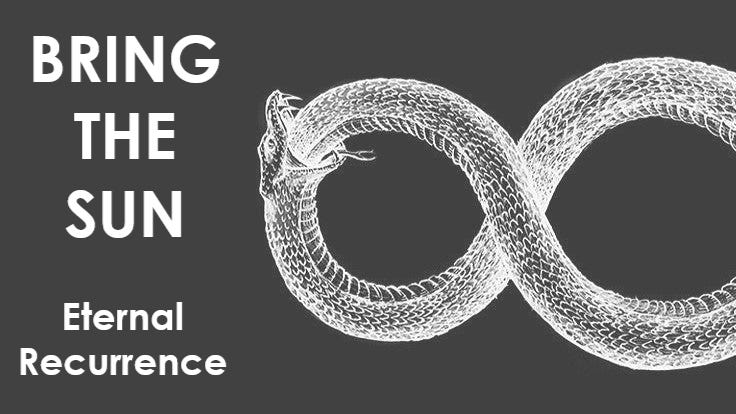
The oldest and most reliable conception of how time unfolds is the cyclical model; imitating the procession of seasons, the movements of the celestial bodies, and the birth and death of living things. As notions of the heroic and divine find themselves in a state of eternal recurrence; the hero with a thousand faces, the ritualist who must rise from the dead, the slaying of the man-eating serpent, the earth mother and her all-devouring shadow; men too have always assumed themselves the part of some grand narrative, one which has a beginning, an end, and a new beginning.
“The correct representation of time,” Rene Guenon determines, “is to be found in the traditional conception of cycles, and this conception obviously involves a ‘qualified’ time.” What it also necessitates, however, is a view of humanity through a counter-progressive lens, as the world moves farther away from the divine central unity (i.e. the “pole”) and closer to the crisis and eventual collapse at the end of a given cycle with each passing day. Guenon writes in “The Reign of Quantity and the Signs of the Times”:
… it is quite natural that in the course of cyclical development both the cosmic manifestation as a whole and also human mentality, which is of course necessarily included therein, together follow the same descending course, the nature of which has already been specified as consisting in a gradual movement away from the principle, and thus away from the primal spirituality inherent in the essential pole of manifestation.
This is the reason why the cyclical model has been all but abandoned in our modern age, for a technological society cannot function in perpetuity without faith in the supremacy of technical advancement. Or rather, as technological society evolves past its need to assuage human sentimentality, man cannot survive in said society without maintaining such a faith, for he, as an atomized individual, is utterly trapped and helpless otherwise.
It has been said by some, like Guy Debord, that cyclical time was displaced by the linear model through the takeover of the monotheistic Abrahamic faiths, all of which posit a future age wherein a messiah will brings humanity to final salvation (by name, these are the Jewish Messiah, or “Mashiach ben David,” the return of Jesus Christ, and “Madhi” in Islam). These also, however, describe a time of struggle and tribulation before the messiah can arrive, a factor that is largely absent from the March of Progress narrative that characterizes modern institutions (but is admittedly still present in some forms of Leftism).
Yet this linear time was not the final model which the technological age would adopt. Instead, time is measured through productivity and through work hours; a “commodified time,” if you will, which works hand in hand with the flattened “mechanized time” of the quantified world (think of timers, the hands of clocks, the standardized calendar, etc). In my essay series “Theory of the End,” I also outlined a highly erratic conception of time peculiar to modernity, which I have dubbed “self-time”:
When we also take into account the fact that various technical fields can have very different ways of viewing time, for instance accounting and politics (election cycles, tax periods, etc.), then what we have overall is a system in which every individual has their own miniature conception of time, often completely separate from those who do not work in the same field or for the same company. Like everything else, time has become atomized and individuated; a “self-time,” if you will, turning one’s view away from the world at large and further inward until he finds it difficult to even communicate with others.
All of this clouds the mind and, alongside a myriad of other factors, makes it impossible to fully place ourselves into the minds of our predecessors. But if we wish to understand the ancient documents and beliefs, we must make the effort to cast off our technicized mentalities and try to inhabit the alien worldview of our distant ancestors.
The primary model of cyclical time utilized by Julius Evola, and therefore by us for at least some parts of this essay series, is the “Four Ages” of the Greeks, as expounded by Hesiod in his text “Works and Days.” These ages, which may already be familiar to many readers, are The Golden Age, The Silver Age, The Bronze Age, and the Iron Age. The Golden Age, which Hesiod claims was overseen by the deity Chronos, brought forth a “golden race of mortal men” who “lived like gods without sorrow of heart, remote and free from toil and grief,” while the subsequent silver race was “less noble by far… like the golden race neither in body nor in spirit” and “lived only a little time in sorrow because of their foolishness, for they could not keep from sinning and from wronging one another.”
The third race, the one of bronze, was described by Hesiod as “terrible and strong. They loved the lamentable works of Ares and deeds of violence... Great was their strength and unconquerable the arms which grew from their shoulders on their strong limbs.” These bronze men inevitably found themselves “destroyed by their own hands and passed to the dank house of chill Hades, and left no name,” and were replaced by us long-suffering men of the Iron Age. “Would that I were not among the men of the [iron] generation, but either had died before or been born afterwards,” laments Hesiod. “Men never rest from labour and sorrow by day, and from perishing by night; and the gods shall lay sore trouble upon them.”
It is worth mentioning that a fifth race, more noble and righteous than the men of bronze, could be placed between the Bronze and Iron ages, in an era which one could call the “Heroic Age.” According to Evola, this era “had only the meaning of a partial and special restoration of the primordial state,” which is reflected in Hesiod’s claim that “father Zeus, the son of Cronos,” bestowed upon some of the Heroes “a living and an abode apart from men, and made them dwell at the ends of earth,” where “they live untouched by sorrow in the islands of the blessed along the shore of deep swirling Ocean.” For the sake of simplicity, we will consider this to be an extension of the Bronze Age going forward.
Evola does not adhere entirely to Hesiod’s description in his hermeneutical approach, rather he generalizes each of the four metallic ages into archetypes which are mapped onto his pseudo-historical narrative. The Hyperborean Golden Age is entirely masculine and spiritually centered, coalescing around the supreme principle in blissfully harmonious fashion. “This era corresponds to an original civilization that was naturally and totally in conformity with what has been called the ‘traditional spirit,’” he writes. Spirituality, or rather the sacred principle, was never separate from the actions of men, but was always in unison with their hearts, minds, and hands. This is, in other words, the lofty state of attainment that Confucius once described when he said that “at seventy, I could follow the promptings of my heart without overstepping the mean.”
As we shift away from the Northmost pole, however, we find that spirituality begins to deviate, eventually acquiring a different flavor while retaining its original noble character. “It emphasizes the relationship with the year (the year-god),” Evola writes, “and thus with a law of mutation, ascent, descent, death, and rebirth.” He continues:
Here we find the influences proper to another principle, another cult, another stock of races, and another geographical region. We notice a differentiating transposition. In order to classify this type of transposition we may consider the most significant point in time for the symbol of the sun as the “sun god,” the winter solstice. Here a new element acquires an ever greater relevance; it is that element into which the light seems to disappear and from which it seems to rise again, almost by virtue of renewed contact with the original principle animating its own life. This symbol does not appear in the traditions of pure boreal stock, and if it does, it appears only in a very subordinated way; conversely, in the southern civilizations and races this symbol is predominant and it often acquires a central meaning.
Evola also notes that, in such a subordinate state, this spiritual framework is different from a Dionysian stage, with its orgiastic frenzies and heavy association with chthonic goddesses; a stage which Evola would place even further South from the Hyperborean pole.
As we move in this southward direction, however, we see the rise in prominence of the sun’s obscuration; an emphasis on the earthly, abyssal, and subterranean, commonly marked with symbols of the serpent, the seas, or the lunar “mother goddess.” “These three characteristic expressions are equivalent to a great degree and are often related to one another (Mother Earth; the generating Waters; the Serpent of the Waters),” writes Evola. “The relationship established between the two principles (the Mother and the Sun) is what gives meaning to two different redactions of the symbolism, the first of which still retains traces of the ‘polar’ tradition, while the second characterizes a new cycle, namely, the Silver Age, and a mingling (which is already a degeneration) of North and South.”
Thus we enter the feminine Silver Age. Alongside the aforementioned movement from solar to lunar, we also have a shift from a Northern global pole to a Western one, correlating with the loss of Hyperborea and movement of populations southward towards Atlantis. For this reason, Evola claims, we see a tendency in Silver Age religion for paradisiacal lands to be placed in the West instead of the North. Examples of this include the Western mountain of the Mother Goddess in Chinese mythology, as well as the Western abode of Osiris. The Western Pure Land of Amitabha in Mahayana Buddhism may also fit into this category, but we must also remember that there were similar Pure Lands in the Mahayana Canon (for instance, Bhaisajyaguru’s Lapis Lazuli Pure Land in the east), with Amitabha’s cults simply being the most numerous and long-lasting.
While, as indicated by the above quotation from “Revolt,” Evola considered this lunar evolution to be decadent in relation to the preceding solar stage, this does not mean it is at all inferior to animalistic nature worship (i.e. a more purely “Southern” spiritualism) or base materialistic spiritual bankruptcy, the latter of which remains the only mode of existence left in technological modernity. He writes:
Indeed, the general symbol of the Silver Age and of the Atlantic cycle was not a demonically telluric or a coarsely naturalistic symbol (as in the case of the cycle of the coarse prehistoric feminine idols), but one in which the feminine principle was elevated to a higher form, almost like in the ancient symbol of the Moon as a purified or heavenly Earth, and as such, ruling over anything terrestrial; a spiritual or moral authority was therefore bestowed upon femininity that predominates over purely material and physical virile instincts and qualities.
Evola also provides us numerous examples from world mythology of this divine feminine eclipsing its solar masculine counterpart:
… the subordination of Adonis to Aphrodite, Virbius to Diana, some forms of Osiris (who was transformed from his original solar form into a lunar god of the waters) to Isis, Iacchus to Demeter, the Asiatic Heracles to Milittas — all of these examples seem to point in the same direction. Little statues of the Mother with child dating back to the Neolithic are found everywhere in the Southern Hemisphere, from Mesopotamia to the Atlantic.
However, the lunar, in its obscuration of the solar principle, creates an imbalance, a kink in the universal equation, gradually resulting in the true fracture between man and woman; an early instance of the creeping atomization which, in our present age, now seeks to render all separate, yet simultaneously level and without quality. Inevitably, this Atlantean sundering brings upon itself a reassertion of the masculine in its shadow form: that of the titanic.
“This is the myth of the Titans,” writes Evola. “They are the Giants. This is the Bronze Age.” In other words, it is the reign of the nephilim, the twisted offspring “born of the sons of heaven and the daughters of men.” Such a dark and oppressive epoch, running red with rivers of blood and bleached white with fields of bone, can only result in the deluge which starts the world anew. On this, Evola states:
In Plato’s Critias violence and injustice, yearning for power, and covetousness are the qualities ascribed to the degenerated inhabitants of Atlantis. In another Hellenic myth it is said that “men living in primordial times [to which Deucalion, who survived the Flood, belonged] were filled with arrogance and pride; they were guilty of many crimes; they broke oaths and were merciless.”
The flip side of the Titanic is the Heroic, which is the reassertion of the virile and masculine over the passive and feminine in accordance with the mandate of heaven. There is indeed a thin line between these two facets, but an integral one. Just as fire scorches flesh, it also forges steel. “It was Prometheus who usurped the heavenly fire in favor of the human races, and yet he did not know how to carry it,” Evola writes. “Thus the fire became his source of torment and damnation until he was freed by another hero, Heracles, who was worthier and also one” (we will see this duality of flame and its titanic potential in our analysis of the Kojiki later).
Once order has been restored, the world finds itself in the Age of Iron, which we still inhabit. In this era, the divine solar principle is blotted out entirely and, once its rays fail to pierce through the gray dismal clouds, it is the material and technical which is of utmost importance; quantity fully reigns over quality and religion is sideline to the realm of mere personal interest, surviving spiritualities rendered entirely passive. Religion then, by necessity, becomes a matter of praying for mercy from uncaring gods and desperately wishing for rebirth into a heavenly paradise after shuffling off from this mortal coil. Humanity will reach its final stage once the remnants of spiritual significance die off and we adhere only to the “food standard,” animalistic societal configuration based purely on quantified material.
In Evola’s estimation, Japan was one of the very last “solar” societies (at least relatively speaking), and through emphasis on its continuous divine monarchy had been able to maintain such a societal ethos even after dramatic industrialization and modernization in the late 19th and early 20th centuries. He writes:
Its traditional national form, Shintoism, exemplifies an influence that rectified and raised to a higher level a cultural milieu that partially derived from a primitive stratum. In historical times, at the heart of Shintoism we find the imperial idea and the identification of the imperial tradition with the divine tradition. “Obeying a command, I have descended from heaven,” it says in the Ko-gi-ki about the founding father of the Japanese imperial dynasty…
Japan has offered an example, unique in its kind, of the coexistence of a traditional orientation with the adoption, on a material plane, of the structures of modern technological society. In the aftermath of World War II, a millenary continuity was shattered and an equilibrium lost, thus marking the disappearance of the last state in the world that still recognized the principle of the “solar” regality of pure divine right.
Indeed, as we will see continuously through this series, the monarchy has always been the “traditional” configuration for human civilization, with the right of the sovereign derived from non-human forces. This means that the function of rule and government was never separate from the realm of the spiritual; the two always necessarily moved in tandem.
Thus, in the oldest civilizations, the dividing line between ruler, as one who communed with the heavens, and priesthood was blurred. “The king, empowered with a nonterrestrial force with its roots in something that is ‘more than life,’ naturally appeared as one who could eminently actualize the power of the rites and open the way leading to the superior world,” states Evola. “Thus, in those traditional forms of civilization in which there was a separate priestly class, the king, because of his original dignity and function, belonged to this class and was its true leader.”
This is demonstrated in the role of the “Chakravartin” of ancient Buddhist and Hindu scripture, who must embody the divine “pole” on earth as the rightful leader of men. Rene Guenon, in his fantastic book “The Lord of the World,” relates this to the swastika, a common polar symbol covered in the last essay. He writes:
‘Chakravarti’ literally means ‘He who makes the wheel turn’, that is to say the one who, being at the centre of all things, directs all movement without himself participating in it, or who is, to use Aristotle’s words, the ‘unmoving mover’. It should be emphasized here that this centre constitutes the fixed point known symbolically to all traditions as the ‘pole’ or axis around which the world rotates. This combination is normally depicted as a wheel in Celtic, Chaldean, and Hindu traditions. Such is the true significance of the swastika, seen world-wide, from the Far East to the Far West, which is intrinsically the ‘sign of the pole’.”
This conception of monarchy will certainly re-emerge later in both our examination of the Kojiki and our exposition of Nichiren Buddhism and Nichirenism. For now, however, let us finally move on to the meat of the matter and examine the Kojiki’s initial creation myth, starting with the enigmatic deity “Amenominakanushi.”
To be continued…