
The Diamond Sword - Chapter 4: Greater Than Death
The fourth chapter of a long ongoing series.

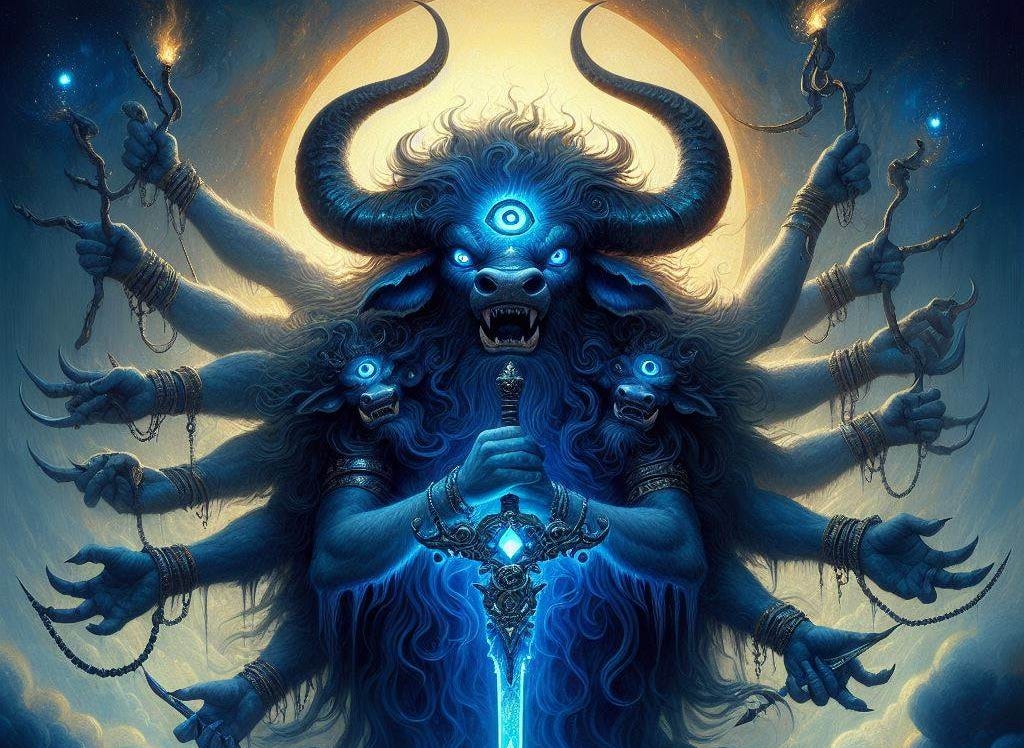
This is the fourth chapter of a long ongoing series. While this chapter in particular can be understood on its own, I highly recommend you check out the others as well.
Chapter 4 - Yamantaka
The Manjusri-Mula-Kalpa, or “The Root Manual of the Rites of Manjusri,” is a ritual text that is among the oldest in the esoteric Buddhist canon. In the book’s narrative the “divine youth” Manjusri, in “the form of a child of great splendor,” comes to our world from the Buddha land Kusumavati (literally “Rich With Flowers;” This land is presided over by a Buddha named Samkusumita Rajendra).
After joining Shakyamuni in giving a sermon to a massive assembly of various sentient beings, the two outline many mantras, rituals, and mandalas to be used by advanced yogins in the elimination of obstacles.
Throughout this text, Manjusri frequently references a being among the assembly who he calls the “Lord of Wrath.” This entity is terrifying in appearance, with six arms, legs, and faces. He has a “wolf’s belly” (i.e. bulging stomach) and red eyes, and wears a garland of skulls over a tiger skin. His hair flows upwards in typical wrathful fashion, “with smoke-colored strands here and there. He is black as collyrium, terrifying, and dark as a monsoon cloud.”
This creature is Yamantaka, the “Destroyer of Death,” and he is one of the five great “Wisdom Kings” of Japanese Esoteric Buddhism. In the Japanese context, he is called “Daiitoku Myo-o.” In Tibetan Buddhism, he is sometimes known by the name “Vajrabhairava,” or “Adamantine Terrifier.” He is also the primary guardian of the Guhyasamaja Mandala, of which either Akshobhya or Manjusri is the primary figure.
For the unaware, the “Wisdom Kings” are figures who represent various features and powers of the eternal “cosmic buddha” (namely Mahavairocana, in Shingon’s case). Sometimes they are categorized as wrathful forms of various Buddhas or bodhisattvas. In the case of Yamantaka, he has been associated with both Amitabha Buddha and, of course, the Dharma Prince Manjusri, the bodhisattva who was able to equal Vimalakirti in his advanced wisdom.
Within the The Root Manual of the Rites of Manjusri, the gentle bodhisattva describes the power of Yamantaka as such:
This mantra of Lord Manjusri, called Yamantaka, Great Lord of Wrath, will crush or summon even the king Yama [god of death], not to mention ordinary beings. As soon as the Great Lord of Wrath is pronounced, all beings will come into Lord Manjusri’s presence, unhappy, frightened, and terrified, their minds disturbed and their spirits broken, without any other refuge, no other protection or recourse apart from Lord Buddha and the divine youth Manjusri.
All of this sounds extremely cryptic until you realize what the “Lord of Wrath” Yamantaka represents. He is not a grim reaper figure, but is instead the embodiment of the Buddhist understanding of death itself.
He is terrible in appearance because that is how the ignorant view their impending fate. These are the people who are “killed” by him. Yet those with an understanding of the true nature of life and death, who have eliminated their clinging to the self, are not “killed,” so to speak:
All immature beings everywhere
Fall under the sway of others if they are careless.
Except for the pratyekabuddhas, the arhats, and the sravakas
Who have extinguished their passions forever,
All of them will be killed by Lord of Wrath
And punished in every respect.
This is why Yamantaka is not a god of death, but is rather the “destroyer” of death. In popular iterations of his myth arc, Yamantaka takes on his monstrous form to terrify the Vedic god of death, Yama, into submission. After this occurs, Yama becomes a servant of the dharma, and is renamed Dharmaraja, or “Dharma King.”
Similarly, practitioners who realize the emptiness of life, death, and rebirth can come to see the inherent purity in everything, including samsara itself. Through this lens, even death can be seen as doing the work of the Buddha, because the eternal cosmic Buddha is something that is far greater than death.
Chapter 4.5 - Greater than Death
One worrying trend I have seen among younger generations as of late is a strange reverence for death. In the Atheist, Materialist, and Rationalist worldview that most young people have been instilled with since birth, death is the ultimate in everything. To them, there is nothing greater than death, and so death rules the realm of consciousness.
So people yearn for death. Life is a mistake that leads to suffering, so outside of indulgence in base sensual pleasures, everyone is just killing time until that black emperor of death decides to take them under its robes. Yet the same people who hold onto this cosmological worldview also grasp at meaning wherever they can find it.
They flutter from one “socially conscious” cause to the next like moths towards a flame. As soon as one runs out of fuel, they quickly move on to the next with nothing grounding them.
The end result of this is the view that the one thing greater than a normal death is a death that is carried out in service of a cause. It doesn’t have to be one cause in particular; anything that is drawing the attention of the “socially conscious” at any given moment will do. So people throw themselves in front of moving vehicles for climate justice or provoke police in order to combat “systemic injustice.” Through this, their worship of death becomes unified with political martyrdom.
The most disturbing aspect of this is not only the seeming veneration of death, but the carelessness with which life is treated. People claim to care immensely about the death and suffering of others on continents they may never even visit, yet are willing to throw away their own lives, and sometimes even the lives of their next-door neighbors, with such casualness.
It’s a spiritual framework that makes no sense, and leads to lives lived as if in a dream. We fight and scream and punch the air in total futility, then it all comes to a sudden end and we… wake up? This is not a way to live life. These people are already dead, at least spiritually speaking, and they are merely waiting for their body to die as well. This is true Nihilism.
Moreover others wish for the total death of humanity itself out of pure resentment. In G.K. Chesterton's book “Heretics,” he described how one of his ideological opponents sought "to throw over humanity with all its limitations and go in for progress for its own sake." When his philosophy didn't work out, he wished "not for a new kind of philosophy, but for a new kind of man."
What Chesterton didn't specify here is that when ideologues like this realize that they will never be able to shape humanity to match their vision, they instead yearn to snuff out humanity entirely. If it's the nature of existence that's the problem, then life itself must be destroyed. We see this thought process play out in extreme anti-natalists, who believe the act of bringing more people into this world to be morally reprehensible, as it only serves to multiply suffering.
In Buddhist terms, these views can be attributed to the “craving for non-existence” or “vibhava-tanha,” one of the three cravings listed in the Buddha’s first sermon at Deer Park alongside the craving for sensual pleasure (kama-tanha) and the craving for existence (bhava-tanha). While we will cover these in more detail in the next chapter, the craving for “non-existence” is particularly relevant, as it is essentially the urge to annihilate one’s own bodily form or other forms within the world of transformation.
Whether through despair at one’s own circumstances or rage at the universe around them, people experience this caving for “non-existence” and act in various destructive ways. They self-harm in order to manifest their internal chaotic state, or they lash out and harm other beings out of petty resentment. Some lock themselves away in their abodes, effectively cutting them off from the rest of the world in attempted defiance of universal interconnectedness, and wait for the universe itself to fade away into nothingness.
Of course, annihilationism is the view of the ignorant. Nothingness does not come, nor will it ever, and the wheel of samsara turns ever onward into eternity. Those who destroy themselves or others in an attempt to make that which they despise disappear will find that nothing truly vanishes, and they will be doomed to transmigrate aimlessly through the realms of rebirth repeating their foolish actions over and over again.
The only possible cure for all of this madness is for people to understand that there is something greater than death, and there are causes and beliefs that last longer than the newest hysteria on social media. It’s not just performative activism that has effects on this world. It’s everything, including the self-hatred and nihilism that people insist on spewing into the collective consciousness every day.
Instead of waiting for death to come and assuming the universe will blink out like a television being turned off after the end of a program, we can use our lives to look towards something greater than ourselves and the petty world of ignorance that we constantly bask in. The dharma presents us with a more comprehensive cosmological worldview that cannot be gleaned from social media posts and textbooks, and it’s this that we can use to cure our collective rot.
It’s for this reason why I spurn “Secular Buddhists” who insist on adopting rationalist metrics for measuring the worth of one’s faith. Buddhism can theoretically be cut down to a nice tidy rationalist self-help philosophy that doesn’t threaten the current status quo, but why would anybody truly want such a thing? It’s like taking pain killers to fight a serious infection. You may feel a bit of relief, but the infection is still there just beneath the surface, slowly breaking down your body.
Our only real way out is to challenge modern spirituality and its culture of death worship with something more meaningful and effective at reducing our suffering. We must terrify death into submission, just as the Lord of Wrath Yamantaka did countless eons ago, and bring it under our domain so it no longer has a grip on our minds.
Buddhism does not worship death, but rather transcends it by understanding it in its full proper context and, through the incredible powers of the eternal cosmic Buddha, all fear and suffering caused by death will eventually be extinguished.
Per the Dhammapada: “Heedfulness is the path to the Deathless. Heedlessness is the path to death. The heedful die not. The heedless are as if dead already.”
Being born as a human is a rare and beautiful thing, even more so when one is able to hear the wonderful Buddhadharma. Here we are, so close to enlightenment, yet we choose to waste away our days on meaningless things until we quietly perish, or we throw our lives away for mere trifles that will be forgotten when the collective attention span inevitably shifts its short focus.
Remember that this life is precious. Do not wander through it as if inside of a dream.
As always, thank you all very much for reading.