
BRING THE SUN - Chapter 6: Kanrodai
Solar and Polar Significance in the Kojiki and Nichirenism

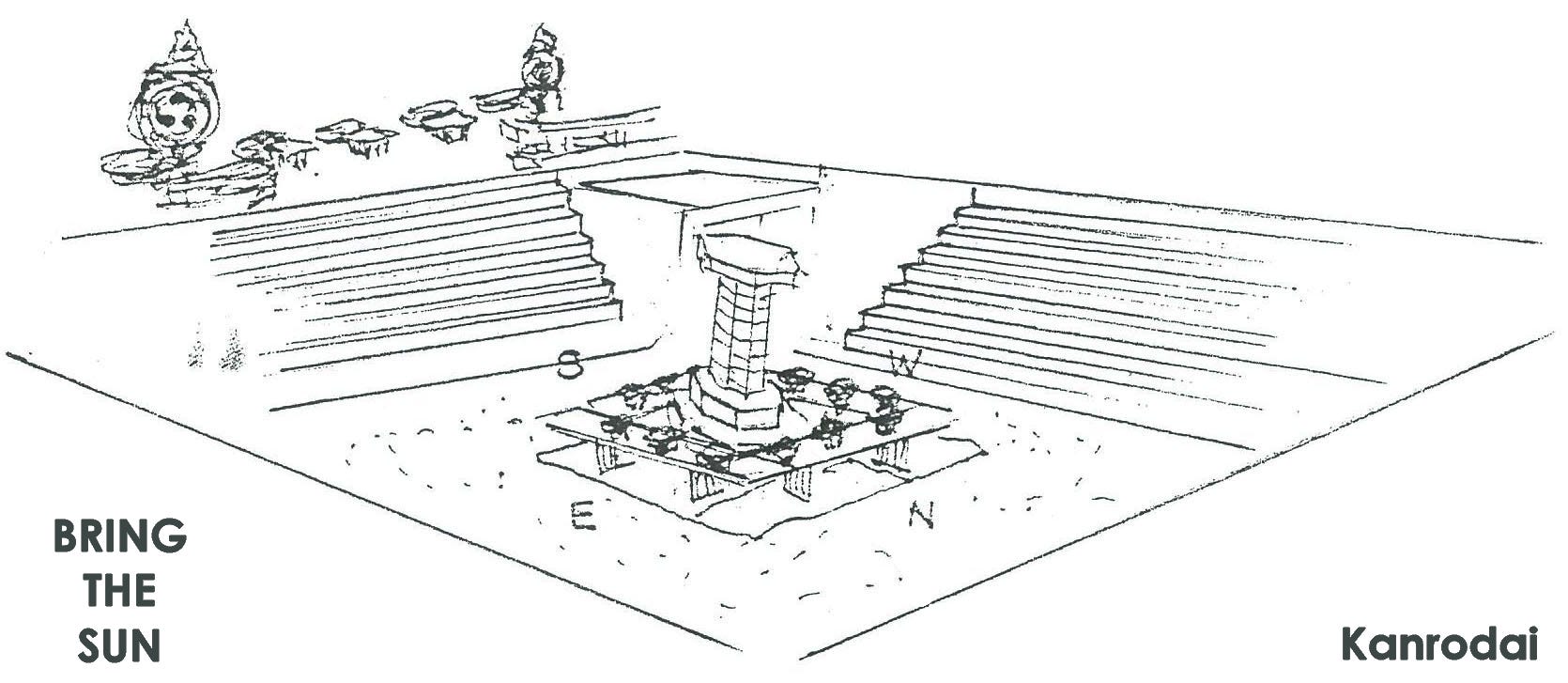
With the descent of Izanagi no Mikoto and Izanami no Mikoto, the Kojiki’s creation story can begin in proper, and we are (mercifully) given a more coherent narrative style from here on out. That does not mean, however, that this section of our myth arc is not riddled with mysteries. In fact, the first appears within just a few paragraphs. It reads:
Hereupon all the Heavenly deities commanded the two deities [Izanagi no Mikoto] and [Izanami no Mikoto], ordering them to “make, consolidate, and give birth to this drifting land.” Granting to them a heavenly jeweled spear, they thus deigned to charge them.
So the two deities, standing upon Ame-no-ukihashi (the Floating Bridge of Heaven), pushed down the jeweled spear and stirred with it, whereupon, when they had stirred the brine till it went curdle-curdle, and drew the spear up, the brine that dripped down from the end of the spear was piled up and became an island. This is the Island of Onogoro.
Having descended from Heaven on to this island, they saw to the erection of a heavenly august pillar, they saw to the erection of a hall of eight fathoms.
The first sentence regarding the “command” of the heavenly deities is worthy of note, as it implies that there is a hierarchical relationship between the deities in heaven, like Kamimusubi and Takamimusubi, and those on earth, like Izanagi and Izanami. However, as we will see in later sections, this heavenly command also comes paired with a certain delegation of heavenly authority.
Regarding the island of Onogoro, Motoori Norinaga writes in his commentary: “The island of Onogoro… appears in Shiki where it says, “It is an island that congealed on its own. That is why it is called onogoro sima, ‘the self-congealing island.’ The name of the island is based on the action of the tide being stirred up, dripping off the tip of the halberd and then drying with a crackling noise.” While there is no consensus on where exactly this supposed island is located, Norinaga, in his work “Kokugoko,” claims that it is “the name of a small island near Awaji Island.”
The Takeuchi Documents once again present a similar, yet interestingly different, version of this concept, with a pair of gods (in this rendition named Ame Hajime and Ame Hashira) originally touching down in Takayama in present-day Gifu prefecture. Wado Kosaka writes in his study of the documents:
The mountain shrines of Kugunoyama and Funayama are also mentioned [in the documents] and there is still a mountain called Funayama (Funa = ship; Yama = mountain) in Hida. The Funayama shrine remains in this place. As regards the history of this shrine, even though it no longer preserves the tales of the descents of Gods in extremely ancient times, its name still conveys in what way the Gods made their descent from the cosmos…
Wado also suspects that the deities set up a “heavenly pillar,” in a similar fashion to the Kojiki’s story, which they used to mark their “observation site.” He links this to a large oblong stone in Mt Goka in current-day Toyama Prefecture.
The “pillar” mentioned in the passage from the Kojiki is actually the most interesting aspect for me. We have already covered the symbolic significance of “two pillars,” but the singular “pillar” here is of a polar nature rather than an indication of cosmic “balance” like the pillars of the previous chapter. It indicates a divine “center”; an “axis mundi” at which the realms of heaven and earth are linked. Indeed, a passage from the Nihon Shoki’s version of this story describes the pair of deities as turning “round the pillar of the land separately” as part of their generative process, marking it as a central implement in the divine creation of earth and potentially a source of this creative power.
Both temples and houses in Japan have historically (and currently, at least to some extent) made use of central pillars as a crucial element of their structures. For houses, this pillar was dubbed the “daikokubashira,” literally “great black pillar,” named after the syncretic god of fortune Daikokuten. In pagodas, it is called the “shinbashira,” which can be translated to “spirit pillar” or “heart pillar.”
Likewise, pillars have been a mainstay of Japanese spirituality, always indicating a divine centrality. This is obviously true for the Kojiki, which associates it with the palace inhabited by Izanagi and Izanami during the creation of the world (i.e. the “hall of eight fathoms”), but it receives even more emphasis in the Shinto-inspired New Religion Tenrikyo. The scriptures of Tenrikyo locate the origin of humanity, which they call the “jiba,” in present-day Nara Prefecture, in the spot where they have constructed their holy see, a temple named the “Tenrikyo Kyokai Honbu.”
Most notable for our purposes is this temple’s principal object of worship: a pillar called the “Kanrodai,” or “Heavenly Dew Platform,” which is placed at the very center of the jiba. This pillar is alternatively referred to as a “shinbashira,” a word which receives special nuanced significance in Tenrikyo’s theology. An article on their official site states:
The term as used in the Ofudesaki [i.e. one of the Tenrikyo scriptures] has two meanings. First, it refers to the Kanrodai, which is the pillar that marks the Jiba, the birthplace of humankind. The Kanrodai, which is to receive the Heavenly Dew from God the Parent, serves as the center for the performance of the Kagura Service, which is the fundamental means of universal salvation.
Second, the term refers to the administrative and spiritual leader of Tenrikyo followers, who have faith in this path, as in the case of the first Shinbashira, Shinnosuke Nakayama, about whom Oyasama said in advance of his birth, “The child to be called Shinnosuke is destined to be the Shinbashira.” The Ofudesaki contains a reference to the “Shinbashira, who is to settle matters within” (III:56).
In the Ofudesaki, there are many verses that seem to indicate both these meanings at the same time – the “central pillar” as the Kanrodai, which is to be set up to mark the source and center of world salvation, and the “central pillar” as the Shinbashira, who occupies the central place among those of us who have faith in this path as our spiritual leader.
In other words, a “shinbashira,” or “spirit pillar,” can refer to both a physical central location and a person who acts with spiritual authority. In more regal terms, it can refer to both the palace and the monarch (i.e. the “unmoved mover”), the centers of the earthly hierarchy in accordance with Julius Evola’s notion of traditional society. “[This] symbolism [of centrality] is embodied in the ziggurat, the Assyrian-Babylonian terraced pyramid, as well as in the master plan of the capital of the Persian kings (as in Ecbatana) and in the ideal image of the cakravartin’s royal palace,” Evola writes. “In these places we find the architectural expression of the cosmic order complete in its hierarchy and in its dependence upon an unmoved center. From a spatial perspective this center corresponded, within the building itself, to the king’s throne.”
Regarding the symbol of the “divine pillar” in particular, we can find it outside of Japanese spirituality as well. The Saxon pagans, for instance, were known to erect large wooden pillars, sometimes using entire tree trunks, as objects of worship. The 11th-century German chronicler Adam of Bremen wrote in “Acts of the Pontiffs of the Hamburg Church” that “they worshipped a large tree trunk erected high in the open air, calling it in their native tongue ‘Irminsul,’ which means the ‘universal pillar,’ as if supporting all things.”
In the realm of Abrahamic religions too we find mention of guiding pillars of divine fire or clouds; a “pillar” here indicating the guiding benevolence of God descending from the heavens above. A passage in Exodus states (per the King James version): “And the Lord went before them by day in a pillar of a cloud, to lead them the way; and by night in a pillar of fire, to give them light; to go by day and night: He took not away the pillar of the cloud by day, nor the pillar of fire by night, from before the people.”
The symbol of the cross, which pre-dates Christianity but is these days synonymous with the faith, could also be interpreted as a pillar which marks a central cosmological point. This becomes clearer when using a three-dimensional cross, with short arms pointing in all four cardinal directions and the long vertical line representing a Y-axis. In Traditionalist author Rene Guenon’s treatise on the symbol of the cross, he related this vertical axis to “the metaphysical locus of the manifestation of the ‘Will of Heaven’” which “passes through each horizontal plane at its centre… the point of complete harmonization of all the elements that go to make up that particular state of the being.” This “Will of Heaven,” in Guenon’s framework, would thus be present at every level of manifested reality, which is in turn represented by the four directional arms. Note that this idea will come into play later in our analysis of the Kojiki.
The “pillar” of Onogoro referenced in the Kojiki seems, at least in my view, to share all of the elements described in the above examples. It is simultaneously a central link to the divine energy of the heavens; an axis mundi which can guide heavenly descent, and from which the deities can overlook creation; and a support for the palace of Izanagi and Izanami, this last facet supplying it with an obvious regal significance. It is not, however, the only “regal” symbol in the chapter’s opening passage.
The symbol of the divine bridge, exemplified here by the Ame-no-ukihashi, or “floating bridge of heaven,” can also be found in the title “pontifex,” originally used by the high priests of the Roman Empire before being applied to the Roman Emperor and finally to the Pope of the Catholic Church. Guenon suggests in his book “Lord of the World” that this term may be of Masonic origin, with the Freemasons often claiming a lineage extending back to the time of King Solomon (roughly 10th century BC). On the subject of the “pontifex,” Evola writes:
Pontifex means “builder of bridges,” or of “paths” (pons, in ancient times, also meant “path”) connecting the natural and the supernatural dimensions. Moreover, the pontifex was traditionally identified with the king (rex). Servius, a late fourth-century commentator on Virgil’s works, reports: “The custom of our ancestors was that the king should also be pontifex and priest.” A saying of the Nordic tradition reads: “May our leader be our bridge.” Thus, real monarchs were the steadfast personification of the life “beyond ordinary life.” Beneficial spiritual influences used to radiate upon the world of mortal beings from the mere presence of such men, from their “pontifical” mediation, from the power of the rites that were rendered efficacious by their power, and from the institutions of which they were the center.
The fact that the “floating bridge of heaven,” i.e. the channel through which, in the words of Evola, the “beneficial spiritual influences” could “radiate,” and the central divine pillar were both commonly thought by scholars of the ancient Japanese texts to have been located somewhere in Japan, it should come as no surprise that the Island nation was often supplied with a special significance surpassing all other countries. Indeed, the Izanagi and Izanami cycle of the Kojiki seemingly concerns itself with only the creation of the Japanese archipelago, with the other bodies of land seen as negligible. On this, Hattori Nakatsune writes in his essay “Sandaiko”:
The floating bridge of heaven is located between heaven and the earth. The bridge is the path from heaven to the imperial country, which is located directly below the bridge, with the various foreign countries located to the east and west, farther away from heaven. The two creator kami [Izanagi~Izanami] give birth to the imperial country. The beginning of the foreign countries starts with the division hither and thither of the imperial land and surrounding water, with the foam and tide naturally hardening. The foreign countries were created from these large and small pieces of hardened material. Takami Musubi and Kamu Musubi gave birth to these hardened pieces of material, each piece being equal. Izanagi and Izanami did not give birth to the foreign countries. This is the original difference between the noble imperial land and the base lands, the beautiful and the evil.
Through this, Japan takes on a capacity similar to Mt. Sumeru in ancient Indian thought or the northern continent of Hyperborea in Julius Evola’s framework. It should then come as no surprise that the New Religious offspring of Shinto belief, like Tenrikyo and Amatsukyo, would take a similar stance regarding the islands of Japan, considering it both the past and future spiritual pole of all of humanity.
The Japanese nation would play a similar role in the philosophy put forth by the 20th century Nichirenists, albeit with some significant variances. They would also utilize the symbol of the “pillar” in an interesting way. But we will have to wait until later in this essay series to cover this subject in full.
To be continued…