
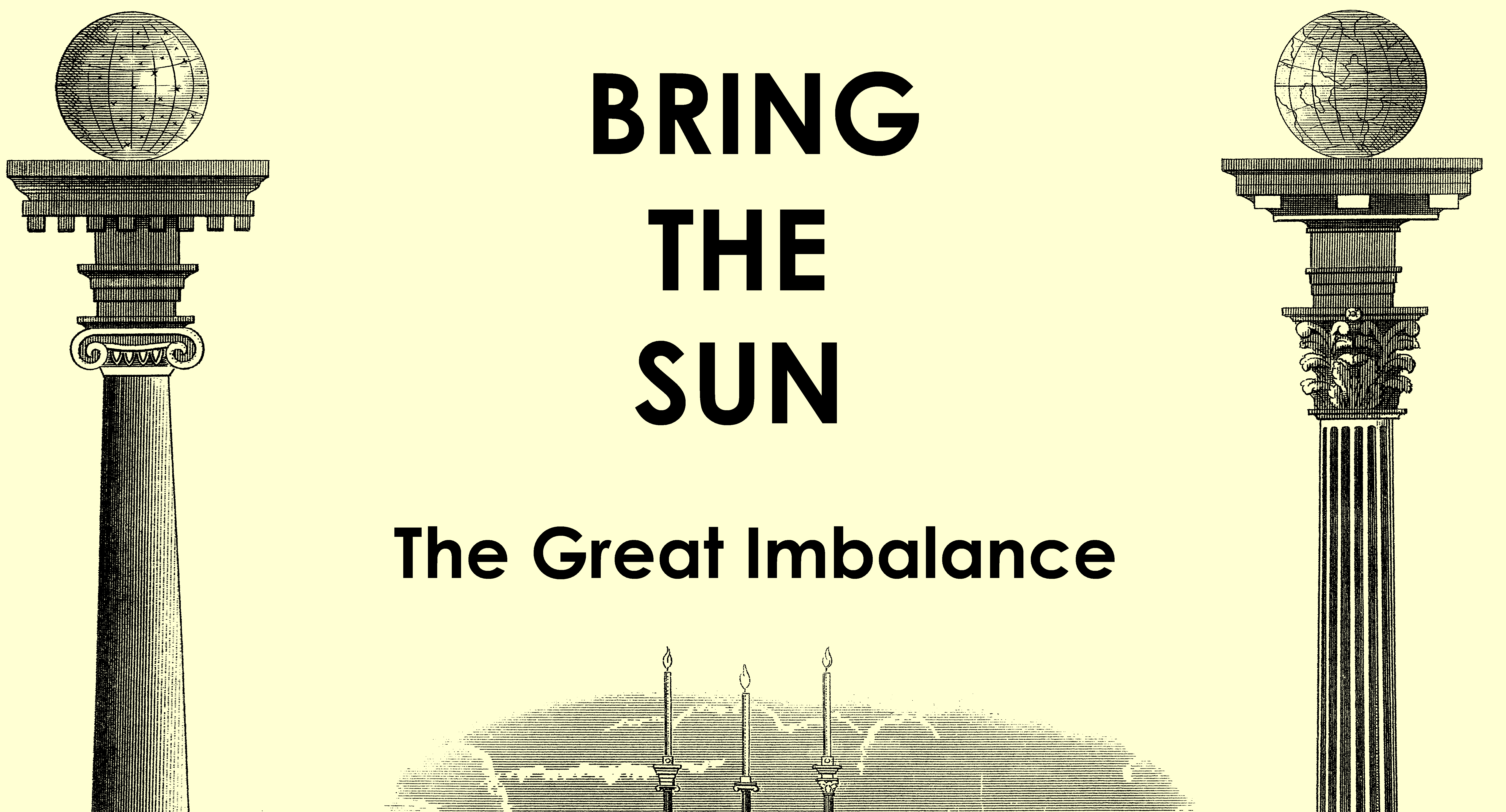
BRING THE SUN - Chapter 5: The Great Imbalance
Solar and Polar Significance in the Kojiki and Nichirenism

“The theory about ‘how the world began’ seems to involve the breaking asunder of a harmony, a kind of cosmogonic “original sin” whereby the circle of the ecliptic (with the zodiac) was tilted up at an angle with respect to the equator, and the cycles of change came into being.”
-From the introduction to “Hamlet’s Mill”
In the second portion of the Kojiki’s cosmological creation myth, there are two kami who come into existence: Umashiashikabihikoji (Elderly Prince Reed-Shoot) and Ame no Tokotachi (Eternally Standing Heaven). These are both generally considered heavenly deities, especially since the “Ame” in “Ame no Tokotachi” is an explicit reference to heaven.
The more earthly counterparts to the aforementioned pair, who are claimed to have been born at a later time, are Kuni no Tokotachi (Eternally Standing Land) and Toyokumono (Abundant Clouds Moor). Like the kami in the prior sections, they are said to have “hid their bodies” after coming into existence. In the Nihon Shoki, Toyokumono is notably paired with a third deity named Kuni no Satsuchi (Land of Right Soil), forming a triad similar to the Zokasanshin discussed in the last essay.
Thus, other than Amenominakanushi and Kuni no Tokotachi, all of the primordial kami, including those said to have been “born alone,” can be interpreted as having a counterpart. This shows a concern not only for duality, but for a sense of sustained balance. These pairs can be viewed as revolving around the original pole of heaven in perfect harmony, maintaining a divine balance that is perhaps necessary to keep the cosmos functional after the arising of duality through power of the two musubi deities.
Indeed, a footnote to the William George Astin translation of the Nihon Shoki claims that the word “hashira or bashira” is used as the “usual auxiliary numeral (like our head of cattle, sail of ships, etc.) for gods in the ancient literature,” thus the three deities of Kuni no Tokotachi, Toyokumono, and Kuni no Satsuchi are literally referred to as “three pillars,” which evokes the idea that these are entities who hold the cosmos in place and keep it from collapsing on itself.
In connection to this, there are passages in the Nihon Shoki describing Kuni no Tokotachi and others as resembling “reed-shoots,” referring to a long thin plant springing up from the earth. Thus these deities are presumably formed on the earth and sprout up towards the central pole of heaven (represented, in this case, by the sun). For me, these references to “pillars” and “reed shoots” bring to mind the idea of connecting heaven and earth; the energies of heaven being channeled by the earthly deities for the purposes of creation and governance.
In fact, in Hattori Nakatsune’s “Sandaiko,” he theorizes that the spheres of heaven and earth, although already having begun to separate by the time of Kuni no Tokotachi’s birth, were still very much connected, thus they cannot yet be considered entirely separate realms. Hirata Atsutane, in his work “Kodo Tai,” also makes an interesting note that the term “earthly kami” was not used as a descriptor until after the descent of Amaterasu’s grandson Ninigi, i.e. after the separation of heaven and earth had reached its completion in Nakatsune’s framework. Atsutane writes:
The kami who appeared when heaven and earth were first created are Ame Minakanushi, Takami Musubi, Kamu Musubi, then Umashi Ashikabi Hikoji, and Ame Toko Tachi. Kojiki calls these five generations of kami “heavenly kami”; therefore, it is clear that the seven kami (from Kuni Toko Tachi to Izanagi and Izanami) were not labeled “heavenly kami.” In spite of this, there is also no record that labels these kami “earthly kami.” The usage of “earthly kami” is used after Ninigi to make a distinction between the kami in heaven.
What we have then is a gradually widening distance between the heavy earth and the ethereal pole of heaven due to a slight imbalance in the primordial fabric of the universe; a “cosmogonic original sin,” which puts the rest of our myth arc into motion. Just as the stars in the night sky gradually shift over time, so too does material existence slip from the divine spiritual balance of the Golden Age and into the more dualistic Silver.
In our analysis going forward, the Golden Age will consist of the reign of the “seven divine generations” (Jpn: Kamiyo-nanayo) over the earth, beginning with Kuni no Tokotachi and Toyokumono (each of whom are considered their own “generation”) and ending with Izanagi no Mikoto and Izanami no Mikoto. Each generation following Toyokumono consists of a pair of deities, one presumably male, and the other female.
The Reikiki, a text on syncretic Ryobu Shinto (or “Two Realms Shinto”) associates the seven generations with the Seven Buddhas of the Saha World listed in the Hinayana scriptures, from Vipasyin Buddha to Shakyamuni, indicating that the generations were viewed in medieval Japan as a long line of succession from one pair of Kami to the next rather than a simultaneous rule.
It’s also interesting to note that the Takeuchi Documents take a similar chronological approach, but list Kuninotokotachi as the 14th Kami instead of the first, with Izanagi no Mikoto being the 21st ruler. The reigns of all these Kami are all described as being billions of years long, with the first seven generations, referred to in the Takeuchi Documents as the “Tenjin Era,” concerned primarily with the creation of the cosmos and Earth. Just like in the Kojiki, there are two ruling gods for each of the generations, one “Sun God” and one “Moon Goddess,” and they are described as acting as “pillars” for the world.
The Takeuchi scriptures are generally considered apocryphal by everyone outside of Kosokotai Shrine, which was originally part of the New Religion “Amatsukyo” or “The Way of Heaven,” founded by Kiyomaro Takeuchi. While these are not by any means authoritative in the study of earlier texts like the Kojiki, we can see from the description above that the composers of the documents had similar ideas regarding successive generations of “two pillars” and had worked these notions into their Shinto-derived theology.
Of course, we should take care to note that the elements described here are by no means peculiar to Shinto and its derivations. The idea of deities arising in a pair, for instance, is exemplified most famously by the ancient Chinese creation gods Fuxi and Nuwa, whose serpentine bodies can also be said to resemble “reed-shoots” (although this may be purely coincidental, as the Nihon Shoki does not explicitly attribute any serpentine aspects to the primordial deities).
The Freemason W. L. Wilmshurst also noted back in 1922 that the symbol of “two pillars” had been a persistent feature of Western spiritual frameworks as well, both within Freemasonry and without. He writes:
The pillars form, and have always formed, a prominent feature in the temples of all great systems of religion and initiation… Many centuries before our Bible was written or the temple of Solomon described in the Books of Kings and Chronicles was thought of, the two pillars were used in the great temples of the Mysteries in Egypt, and one of the great annual public festivals was that of the setting up of the pillars. What, then, did they signify? I can deal with the subject but very superficially here. In one of their aspects they stand for what is known in Eastern philosophy as the “pairs of opposites.”
Everything in nature is dual and can only be known in contrast with its opposite, whilst the two in combination produce a metaphysical third which is their synthesis and perfect balance. Thus we have good and evil; light and darkness (and one of the pillars was always white and the other black); active and passive; positive and negative; yes and no; outside and inside; man and woman. Neither of these is complete without the other; taken together they form stability. Morning and evening unite to form the complete day.
It is this balance, however, which would inevitably be disrupted, and with it would come a dramatic shift in the metaphysical polar dynamic.
To be continued…