
BRING THE SUN - Chapter 4: The Lord at the Center of Heaven
Solar and Polar Significance in the Kojiki and Nichirenism

“The emperor of the South Sea was called Shu [Brief], the emperor of the North Sea was called Hu [Sudden], and the emperor of the central region was called Hun-tun [Chaos]. Shu and Hu from time to time came together for a meeting in the territory of Hun-tun, and Hun-tun treated them very generously. Shu and Hu discussed how they could repay his kindness. ‘All men,’ they said, ‘have seven openings so they can see, hear, eat, and breathe. But Hun-tun alone doesn’t have any. Let’s try boring him some!’ Every day they bored another hole, and on the seventh day Hun-tun died.”
-Chuang Tzu, translated by Burton Watson
It may seem strange, and it certainly did to me at first, that the very first deity to appear in the cosmos according to the Kojiki did not have a dedicated cult at the time of the text’s composition, nor was he worshipped by any existing cults in any significant manner. However, my confusion over this matter arose from expectations rooted in a familiarity with monotheistic Abrahamic faiths; ones which didn’t apply to religions outside the Western cultural sphere, let alone to Japan’s highly unique indigenous faiths.
To automatically assume this first deity, named Amenominakanushi, to be the all-powerful intelligent creator of the cosmos would be to repeat the fallacy of Mahabrahma in the Buddhist Dirgha Agama Sutra, who proclaimed that “I alone have been here before as father of all sentient beings prior to their appearance, because they appeared here after I did, and [thus] those beings are ones whom I created.”
Moreover, it would be unwise to treat Amenominakanushi as the lord of all Heavenly Kami simply because he is the oldest. As the famed Kokugaku thinker Motoori Norinaga once wrote: “There is no particular reason to think that coming into being earlier indicates superiority, nor that coming into being later indicates inferiority. If it were so, wouldn’t it be true that all the deities that came into being before Amaterasu Omikami were superior to her?”
However, as the first to come into being, it’s clear that there is some significance to Amenominakanushi’s inclusion in the Kojiki’s cosmic creation myth, especially considering his name means something akin to “Divine Lord at the Center of Heaven.” What does it all mean?
My first instinct when researching this topic was to explore the association between Amenominakanuchi and the syncretic Buddhist deity Myoken Bodhisattva. This seemed particularly relevant considering that many of the Myoken Shrines switched to enshrining Amenominakanushi after the formal separation of Shinto and Buddhism in the Meiji era, establishing a historical precedent for linking the two together.
Indeed, the implication that Amenominakanushi is at the “center of heaven” seems to indicate a connection to the Pole Star, which is the very center of the night sky in astrological terms. Hirata Atsutane, another famous Kokugaku thinker who succeeded Norinaga, echoed this apparent relationship in his essay Koshiden, writing that “if one asks where the dwelling of this great kami is, it is in the very center of heaven, very highly elevated, in a still and unmoving place, namely, the so-called pole star, the point forming the fulcrum of heaven; it is there that Amenominakanushi no kami resides.”
While it’s apparent that such a connection had been established by the Edo era, can we reliably trace the dipper’s religio-cultural significance back to the time of the Kojiki’s composition? It seems the case that star worship had been a relatively rare phenomenon prior to the importation of Taoist and Buddhist influence via the Korean Peninsula in the Asuka era. One possibility is that, with the sun representing the Highest Heaven of Takamagahara, the stars were outside the influence of the divine pole, and thus untrustworthy. Indeed, we can see a prominent example of this in the Nihon Shoki, with warriors sent by the Sun Goddess Amaterasu Omikami violently subjugating a demonic star deity named Amatsu Mikaboshi during the land transfer legend.
This assumption would place the importation of Pole Star veneration perilously close to the time of the Kojiki and Nihon Shoki’s composition, blurring the timeline regarding a potential connection to Amenominakanushi. However, one thread we can pull in order to achieve some clarity is the Pole Star and Big Dipper’s association with the emperor who, by the mid 8th century, wore a ceremonial robe bearing the Big Dipper on his back, a tradition which continued until the Meiji era. Lucia Dolce’s 2006 article “The Worship of Celestial Bodies in Japan” states:
In ancient Chinese thought, the Pole Star, apparently immobile at the centre of the northern hemisphere, embodied the Heavenly Emperor. Accordingly, it became a symbol of and metaphor for the sovereign on earth, in China as well in Japan, and object of royal rituals at court. At New Year the emperor himself invoked the Big Dipper, before paying homage to heaven and earth and the four directions. The robes that he wore during his accession abhiṣeka (sokui kanjō), an initiation ceremony conducted according to Tantric ritual, were decorated with the seven stars of the Big Dipper on the back, while the sun and moon were depicted in the front – a composition signifying the central power of which the emperor was the repository. First worn in Japan by Emperor Shōmu in 732, this robe continued to be used for centuries; Emperor Kōmei was the last to wear it, in 1874.
Conventional dating of the Kojiki places its completion just a couple of decades before this tradition would have started, meaning that it’s entirely likely there would have already been an established association between royalty and the Northern Dipper (and, by extension, the Pole Star) at the time. Yet Bernard Faure’s book “The Fluid Pantheon,” utilizing traditional sources, dates the importation of Myoken faith far earlier than this. He writes:
The introduction of the Myoken cult to Japan is traced to the arrival of a Korean prince named Imseong (J. Rinsho). According to legend, this prince was the third son of a Paekche king. In 611 (var. 595), during the reign of Empress Suiko (r. 593-628), he came to Japan and settled on Mount Shiragi in Yatsushiro (Higo province, Kyushu). Not surprisingly, Myoken became popular among clans of Korean descent. He was in particular the tutelary deity of the Ouchi lineage in Yamaguchi (Suo province), which claimed descent from Imseong. According to the origin story of that lineage, Imseong landed in Suo province, not Yatsushiro. Another account states that the Myoken cult was brought from Yatsushiro to Suo by members of the Ouchi lineage. At any rate, the Ouchi lineage was instrumental in developing the Myoken cult in both places.
All of this points to a considerable possibility that relatively new beliefs around the stars which made their way to the Japanese archipelago from places like Korea could have influenced the Kojiki’s cosmological narrative. However, when exploring the finer details of the relationship between Amenominakanushi and Myoken, I found the prospect of identifying them as the same deity entirely untenable. In order to illustrate why, let us first examine the scriptural origin of Myoken faith. Bernard Faure writes:
The locus classicus for the esoteric Myoken is the Dharani Sutra [Spoken by] the Seven Buddhas and Eight Bodhisattvas, in which he declares that he is the bodhisattva of the Northern Chronogram (Hokushin E, a term that can literally mean “Northern Dragon”) and that he has vowed to protect all countries. He claims to be “the first among all stars, the true immortal among all immortals, and the commander of all bodhisattvas.” The identity between Myoken and Hokushin [i.e. the Pole Star] is reiterated in many sources.
We can see many of Myoken’s facets already taking shape within just the small scriptural passage quoted above by Faure. He is the “first among stars,” meaning overtly celestial in nature, an “immortal,” or a conventional deity in the Chinese sense (the Dharani Sutra in question is commonly thought to have been at least compiled in China), and he is a “commander of bodhisattvas,” implying both a regal nature and that he has taken a Buddhist vow of bodhisattvahood to actively lead all sentient beings to liberation. He is simultaneously an astral deity, a Chakravartin (or “Wheel Turning King”) type figure, and a Buddhist saint.
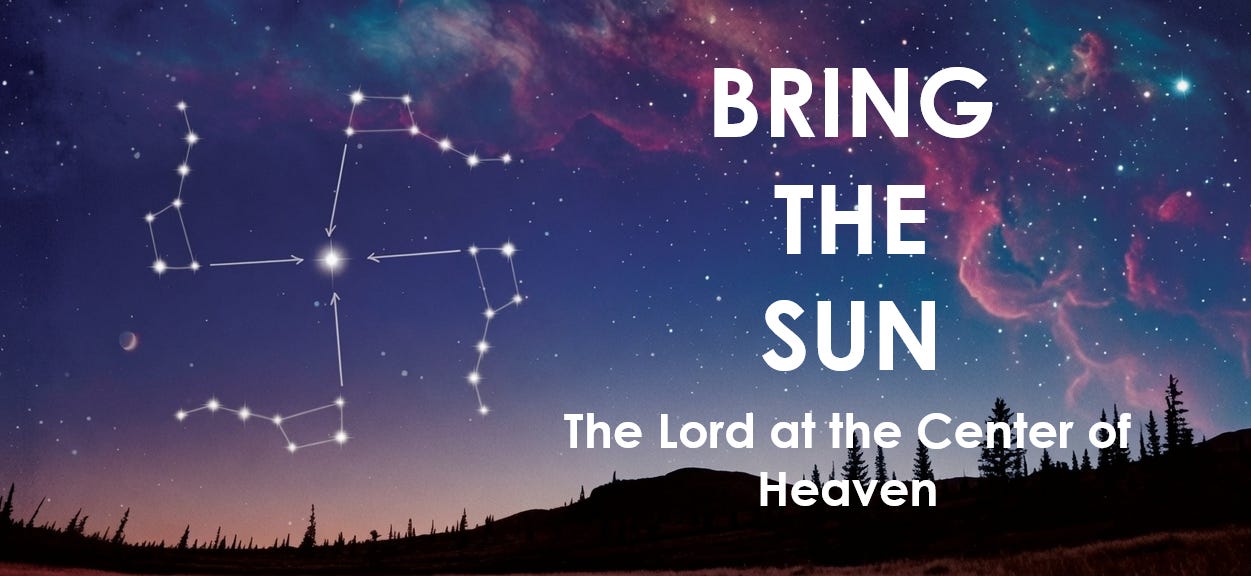
These elements are embodied through his most popular iconographical appearance, which is occasionally called the “Nose Myoken” due to it being created in the Nose District to the north of present-day Osaka. In this form, Myoken takes on the guise of an armored military commander raising a sword at a right angle above his head, imitating the bent arm of a swastika; thus Myoken himself acts as the Pole Star and his blade becomes the Dipper. He outwardly resembles a martial Taoist god, yet is also worshipped as both a Bodhisattva and a Kami, essentially combining all of the major elements of Japanese religion into one powerful syncretic figure.
The problem in regards to a theoretical connection to Amenominakanushi is that our “Lord at the Center of Heaven” shares none of these traits. Let’s take a look at the Kojiki passage in question (per Basil Hall Chamberlain’s translation):
The names of the Deities that were born in the Plain of High Heaven when the Heaven and Earth began were [Ame-no-mi-naka-nushi-no-kami], next [Taka-mi-musu-bi-no-kami], next [Kami-musu-bi-no-kami]. These three Deities were all Deities born alone, and hid their persons.
Amenominakanushi is said to have “hid his person” or “hid his body,” meaning he was rendered invisible immediately after he sprung into existence. Myoken Bodhisattva does not hide his form, considering he manifests as the Pole Star, which is always visible in the night sky. Amenominakanushi is also notably absent from the Kojiki’s narrative for the remainder of the text, in stark contrast to someone like Takamimusubi, who plays a very active role in the Age of the Gods and beyond. Myoken, on the other hand, is thought to personally descend from the heavens to aid devotees and Buddhist practitioners and even curse those he saw as deserving punishment. Per Faure:
We know from tales found in the Nihon ryoiki that Myoken was already the object of popular devotion by the early Heian period. In one story, he manifests himself as a deer in order to return stolen silk robes; in another, he appears again as a deer and helps locate a monk who had stolen money donated for the performance of a lamp-offering ritual dedicated to Myoken; in a third story, he rescues a fisherman from drowning. In addition to these types of aid, Myoken was invoked in cases of eye disease. Here, however, we get a hint of Myoken’s ambivalence: Myoken could cure diseases, but he could also provoke them. In the diary of Fujiwara no Yukinari (972-1027), the eye disease of Ichijo Tenno (r. 986-1011) is attributed to a curse from Myoken.
By all accounts, these are two very different types of deities, with Amenominakanushi seeming more abstract and passive than the very anthropomorphic and active Myoken Bodhisattva. But if this is indeed the case, what exactly is Amenominakanushi’s function? Realizing that I had hit a wall with the Myoken connection, I took a step back and recalibrated. After some contemplation, it soon became clear that I would not be able to truly understand Amenominakanushi’s significance without also taking into account that he was presented as part of a trio in the text of the Kojiki.
The triad is a common configuration for deities in Eastern religion (and if one counts the holy trinity of Christianity, Western religion as well). Prominent examples include the “Trimurti” of Hindu doctrine (Brahma, Vishnu, and Shiva, representing creation, preservation, and destruction respectively), and the Three Pure Ones of Chinese Taoism, who are said to all spring from a cosmic unity of the “one.” It is, however, a different Taoist trinity which I would like to focus on for the time being: that of yin, yang, and wuji.
First, I want to explore the names of Kamimusubi and Takamimusbi using a passage from Motoori Norinaga’s commentary on the Kojiki, Kojiki-den:
The taka of this name is a beautifying appellation; another name by which he is known is Takagi no Kami “the high-tree kami.” The mi is also ornamental. Kami Musubi is a name paired off with Takami Musubi, and so both these names have mi attached… The word musubi is written with borrowed Chinese characters; musu means “to give birth to.” That is why Japanese call sons and daughters, their offspring, musuko “son” and musume “daughter.” Also, like moss, having a plant reproduce and grow is called musu. The Nihon shoki compilers wrote 日 bi (fi) with the character for spirit, and this fits well. Everything that has a mysterious air about it is called fi. The sun goddess who resides in the High Plain of Heaven gazes down from her land, and we call her fi “sun.” This is because there is no such thing on the earth, and she was given this name as she is the most mysterious and superior of all.
Through this lens, we can understand the term “musubi” to indicate something akin to a principle of “solar generation.” The “musubi” deities generate the universe, which radiates forth like the light of the sun; “just as though innumerable strands were stretched out and woven from [a] single point,” as Hirata Atsutane writes in his explanation of Amenominakanushi. Thus the musubi deities are in actuality the ones who actively generate the cosmos.
With this in mind, I turned to Western esotericism for inspiration, borrowing the three universal principles of “attraction, repulsion, and circulation” outlined by Mary Anne Atwood in her text “A Suggestive Inquiry Into the Hermetic Mystery.” “These three principles of attraction, repulsion, and circulation, the universal accord of life, are everywhere and in all,” Atwood writes, continuing:
Attraction is the first principle of motion in nature; this is generally admitted, but the origin of this universal attraction is occult and incomprehensible to the ordinary human understanding. Repulsion is the second principle, and a necessary consequence of the first by reaction. Circulation is the third principle, proceeding from the conflict of the former two.
All motion is derived from this threefold source in its reciprocal relations, which are diversified according to its qualifications with the matter. The attraction, repulsion, and circulation in the sun and stars move the planets in their orbits; the same principle in each globe performs the rotation on its axis, and the satellites partake the same motion from their primaries. Every quantity of matter, solid, fluid, or gaseous, when separated from the rest by its quality or discontinuity, is possessed individually by the same principles, however infinite the variety of substances, natural or artificial, great or small; vegetable and animal forms and motions are no less evidences of these three principles than the heavenly and earthly bodies.
When relating this to our triad of primordial Kami, “attraction” and “repulsion” could be represented by Takamimusubi and Kamimusubi, while Amenominakanushi acts as the central pole around which the “circulation” happens. Expressed in visual terms, Amenominakanushi would be “wuji”; a blank circle or a dot symbolizing limitless undefined primordial potential. After adding the two musubi deities, the shape would resemble a small circle inside a larger one, as described by eminent scholar of the Takeuchi Documents Kosaka Wado in his theory on the nature of the “original God” of the cosmos:
In a passage about the Creation of Earth in the Chinese “Thirty Five Almanacs” there is the expression: “it was altogether as light and soft as a chicken’s egg”, but it is impossible to think that this expressed only a light and soft state. As everyone knows, a chicken’s egg has a yolk in the middle with the white of the egg as a second structure surrounding it. Reflecting on this, the following thought came to mind. Might not a small dot (comma) in a large dot, or rather the “•” in a circle be the expression of God himself?
The circulation of the musubi deities around the central “Lord in the Center of Heaven” would then result in duality, or “taiji,” which would exist simultaneously with the invisible non-dual realm of original unity. As a passage from the 11th century Chinese treatise “Taijitu shuo” states:
Non-polar (wuji) and yet Supreme Polarity (taiji)! The Supreme Polarity in activity generates yang; yet at the limit of activity it is still. In stillness it generates yin; yet at the limit of stillness it is also active. Activity and stillness alternate; each is the basis of the other. In distinguishing yin and yang, the Two Modes are thereby established. The alternation and combination of yang and yin generate water, fire, wood, metal, and earth. With these five [phases of] qi harmoniously arranged, the Four Seasons proceed through them. The Five Phases are simply yin and yang; yin and yang are simply the Supreme Polarity; the Supreme Polarity is fundamentally Non-polar. [Yet] in the generation of the Five Phases, each one has its nature.
In this same sense, I believe that the alternating powers of Takamimusubi and Kamimusubi also generate the rest of the cosmos in the Kojiki. Amenominakanushi would then be like Hun-tun, the faceless being representing the primordial egg of chaos, and whose attainment of a face ultimately resulted in his “death” (for undifferentiated chaos is no longer chaos once it gives way to order).
While I had originally assumed this to be a novel theory, I was delighted to discover that there was precedence for it among Japanese thinkers. Tsurumine Shigenobu, influenced by Dutch Astronomy, wrote treatises in the 19th century linking the mythology of the Kojiki to Western thought, suggesting that “the fact that there are particles [bunshi] in all things is probably a result of the action of the [kami] of productive power (Mimusubi), while the fact there is gravity is a result of the action of [the kami] Minakanushi.” He continues:
This gravity cannot be seen with eyes or taken up in the hand, and like the attraction between magnets and iron, is something that mutually pulls and attracts things together. It is because of the existence of this gravity that particles coalesce and thus the sun, moon, planets and earth spontaneously take their proper form. As a result, when one speaks of the “land illumined with heavenly crimson shining,” it was due to the actions of these three kami that [that land] came into being.
Moreover, Mutoba Yoshika, another 19th century thinker, placed Amenominakanushi as not the Pole Star, but rather the center of the solar system located in the sun; a gravitational “pole,” so to speak, writing that “among the heavenly bodies of distant empty space --- with the exception of the five planets (and some others) --- are suns [amatsuhi], and each of those suns is surrounded by a great void at its border, to the limit of which light is emitted. These shining things, these globular stars, all come into being as a result of the divine virtue of the three kami.”
In accordance with the more scientifically-minded reasoning of these thinkers, I would like to interpret Amenominakanushi no Kami as the original “polar” deity; i.e. the “pole” which existed before the Pole Star or the sun, and whose influence continuously works in the abstract, providing divine order to the previously undifferentiated matter of the cosmos.
To be continued…
The relationship between Takamimusubi and Ame-no-Minakanushi reminds me quite a lot of the Varronian interpretation of the relationship between Jupiter and Janus. Jupiter is the constant force rationalizing and generating the entire world, but Janus is the source of all beginnings, and therefore Janus is invoked first in prayers and is considered to have come first, despite being of lower rank than Jupiter. I suppose a similar relationship would be that between Vishnu and Brahma. Although, the Hindus eventually placed Brahma as springing forth from Vishnu so as to avoid confusion about which one is more powerful.
You might find other elements of Roman religion, especially early Roman religion, applicable in the Shinto context. IIRC every Roman god may have originally been a duo, a male and female god, and I know in your next post you talk about primeval Kami coming in pairs.