
BRING THE SUN - Chapter 3: Introduction to the Kojiki
Solar and Polar Significance in the Kojiki and Nichirenism

“Space is expanding; there are spirits coming from the center, right? We’re going counterclockwise.”
-Denny Brewer in the song “Firewall” by Bright Eyes
What exactly is the Kojiki? Whenever someone begins researching Shinto, the Kojiki, or “Record of Ancient Matters,” is one of the first texts, if not the first, that they will find themselves studying, as it is commonly considered the oldest surviving domestically produced text in Japan (tradition argues that this designation may go instead to the three Buddhist sutra commentaries ascribed to Prince Shotoku, but many scholars seem to disagree). However, the Kojiki, like all such ancient works, was produced under circumstances which are important to take into account when examining the text with any scholarly rigor, and the Kojiki’s circumstances in particular happen to be quite fascinating and fraught with mystery.
The Kojiki is not the first ancient record, merely the earliest which has survived the ravages of time, and the details of its composition have been largely clouded by chronological distance. What does at least seem to be clear is that one of the primary motivating factors in the Kojiki’s composition was the will of the Imperial House to correct the genealogy of the royal families, a matter mentioned in the preface of the surviving text itself. Donald L. Philippi elaborates in the introduction to his translation of the Kojiki:
It is easy to understand that by the reign of Emperor Temmu the introduction of foreign culture should have produced, as a reaction, an increased interest in the nation’s origins and the native civilization. But an even more important consideration must have been the need for authoritative genealogical accounts by which to consider the claims of the noble families and to reorganize them into a new system of ranks and titles.
At a time when noble families based their claims for distinction on ancestry and when questions of precedence and rank were decided by considerations of birth, ancestry, and degree of relationship to the imperial family, it is only natural that falsification of family records should have reached alarming proportions. It was, in fact, vital to the state to establish a definite system of ranks and titles based on a “correct” genealogical account acceptable to the imperial family, and we find evidence of this intense concern for genealogical data on almost every page of the Kojiki.
This monumental task was handed to an individual named Hieda no Are, a 28-year-old of disputed gender who was said to be “endowed with remarkable intelligence and powers of memory.” At Emperor Tenmu’s command, Are went about learning (and perhaps even memorizing) both multiple source texts and oral traditions. However, nothing was apparently put on paper until the reign of Empress Genmei, who finally ordered O no Yasumaro to “record and present” everything Are had learned. Philippi continues:
In the past there has been disagreement about the exact nature of Yasumaro’s role in the compilation of the Kojiki. It now appears that, having received the imperial command, he set to work re-writing the documents “learned” by Are, taking great care to preserve their linguistic and semantic peculiarities by a graphic system skillfully combining phonetic and ideographic use of Chinese ideographs.
The text’s idiosyncratic use of Chinese characters is, in fact, one of its most notable features, as mentioned by Basil Hall Chamberlain in the introduction to his own translation. “The ‘Kojiki,’ as being almost if not quite the earliest Japanese book, is a puzzling medley of Chinese and Japanese,” he writes. “Sometimes the Chinese character is the picture of an object or a thought, just as it is in the Chinese tongue; at other times it is a mere sound or syllable, making part of a Japanese word, and wholly divorced from its Chinese meaning. Thus the ‘Kojiki’ is very hard to read.” This aspect of the text separates it from its equally famous brother, the Nihon Shoki, which was composed in a far more conventional Chinese style.
Due to the importance of the Kojiki’s genealogical aspect, it is impossible to separate it from its political context and, in fact, some scholars extend such political influence even to the text’s more famous mythological aspect. Foremost among them is Tsuda Sokichi, whose position on the ancient records in the early 20th century is summarized by Isse Yoko in the 2019 article “Revisiting Tsuda Sokichi in Postwar Japan”:
Tsuda’s own position on these several issues was as follows: (1) jindaishi 神代史, the history of the Age of Gods that occupies the first half of the Kiki, was created for the political purpose of explaining the origins of the imperial family; (2) the Kiki authors employed a combination of fanciful tales, popular ideas about the imperial family, religious and ceremonial accounts, and Chinese thought and folktales; (3) the earliest authors were intellectuals who enjoyed some rank and position in the Yamato court during the mid–sixth century; and (4) many sections of the Kiki were altered by authors who rewrote the narratives from the mid sixth through the early eighth centuries.
John Breen and Mark Teeuwen’s “A New History of Shinto” acknowledges the logic behind these assertions, yet points out the potential contradiction posed by the Nihon Shoki, which was completed a short time after the Kojiki and had become, by far, the favorite of the Imperial House, despite its seeming de-emphasis of mythological themes which would have been deeply important to its supposed legitimizing narrative. “The most conspicuous difference is that Nihon Shoki omits nearly the entire tale of Okuninushi,” the authors write. “Nihon Shoki appears less interested in giving credit to the earthly deities than Kojiki, and focuses even more narrowly on the heavenly dynasty of the Yamato emperors.” The book continues:
Equally striking is the fact that Nihon Shoki tones down the solar imagery of Kojiki. In Nihon Shoki, it is Takamimusubi alone who orders the pacification of the land and grants rule over the Japanese islands to Ninigi. This text never refers to Amaterasu as the ancestor of the imperial lineage; it even appears to avoid the character for “sun.”
The late seventh century saw the creation of a Chinese-style imperial state in Japan, and it is understandable that it was seen as desirable to adapt the imperial legends to Chinese standards. However, that does not explain why the Nihon Shoki should include numerous parallel versions, nor why it de-emphasizes both the dynasty’s solar symbolism and its “earthly” aspects as a dynasty that, while being of heavenly origin, had allied itself with the powerful deities of the earth through marriage, agreement, and conquest. These are very serious problems, which question the traditional account of Yamato’s self-authentication by mythological means.
Regardless of the reasons, it is clear that some change to the mythology had to have occurred at some point, considering that, in the early Age of the Gods section of both texts, there seems to have been a weaving of several different traditions into one coherent narrative (even if it is one which may have significantly pre-dated the texts in question). This element did not escape the notice of Philippi as he worked on his translation of the Kojiki. He writes in his introduction:
In the mythology we find reflections of two separate myth worlds: the [Takamagahara] myth world, home of the heavenly deities who were ruled by Amaterasu [Omikami] and worshipped by the Yamato court and the aristocracy aligned with it; and the world of the earthly deities, represented as autochthonous gods of the land-mountain deities, sea-deities, deities of the home and hearth, etc. - and attached to [Okuninushi], a culture-hero and land-creator deity whose center of worship was at [Izumo]. The Land-ceding myth sequence, which precedes and sets the stage for the Heavenly Descent sequence, appears to be a mythical statement of a compromise settlement between two religious systems and ways of life: the [Takamagahara] religion, characterized by agricultural rites and concepts of divine kingship, and the earthly deity religion, based on older and more popular beliefs.
The theoretical early “earthly” tradition, now often associated with Izumo and its shrine network centered around the “Lord of the Land” Okuninushi, could have potentially arisen out of popular agriculture-related worship of various local nature spirits. An possible example of such beings is provided in the ancient Hitachi Fudoki (which would have been completed not long after the Kojiki and Nihon Shoki):
During the reign of Emperor Keitai [early sixth century], Matachi of the Yahazu lineage cleared the reed plain in the valley to the west of the [present] district [office] and opened up new rice fields there. Then, yato-no-kami flocked together and appeared in great numbers, stopping people from entering and cultivating the fields. According to local people, yato-no-kami have the bodies of snakes, carrying horns on their heads. If one looks back at them while fleeing, one’s house and kin will be wiped out and one will have no descendants.
It’s worth noting that it is common for the earthly and oceanic Kami to be associated with serpents, with Okuninushi himself included, a detail that will be relevant to the solar/lunar dichotomy.
The “solar” tradition associated with Ise Shrine, as noted by Philippi, would have been aristocratic in nature; shared primarily amongst the nobility of the early eras, with the rest of the population being largely excluded, and it wouldn’t be until well after the Kojiki and Nihon Shoki were composed that the worship of Amaterasu would become widespread across Japan. As we will see, it is in large part this apparent divide between two ancient traditions, one “solar” and one “earthly,” which makes the Kojiki so conducive to analysis through the Evolian framework outlined in the previous two chapters.
Regarding the difference in popularity between the two texts, it’s commonly thought that the Nihon Shoki was preferred for both its ease of understandability and its scope. Due to its inclusion of mythological variances, stemming from its presumed wider range of source texts, the Nihon Shoki seems at first to be the more ambitious of the two projects, and thus the superior of the pair. This assertion of superiority, however, was challenged by the Kokugaku scholars of the Edo period, most notably Motoori Norinaga, who authored a commentary on the Kojiki.
“The reason both Kojiki and Nihon Shoki exist is because the court at the time was terribly fond of Chinese learning, and Kojiki’s text was so bland that they feared the work would seem unbecoming when compared with the histories from China,” Norinaga explains. “They ordered a compilation that relied on a variety of works, adopting a chronological system, imitating Chinese records, even adding segments from Chinese texts… since Nihon Shoki’s texts were more magnificent than anything compiled earlier, this became the orthodox history and the court ordered no further compilations.” He goes on to specify that Kojiki still managed to survive over the ages “because it differed so much from the other earlier compilations, it being a true representation of ancient things.” He elaborates:
First, in ancient times, there were no historical records, everything transmitted by word of mouth. These oral traditions were not necessarily passed down in the form recorded in Shoki, but the true form is preserved in Kojiki. Nihon Shoki is mainly concerned with Chinese philosophy, and its sentences are highly ornate, while Kojiki has nothing to do with Chinese learning, but records the ancient traditions in such a way so these will not vanish.
In this sense, it is not just the antiquity of the Kojiki, but its unusual nature which preserves phonetic elements that makes it more valuable for a scholar of the ancient Japanese matters. It is ironically the very feature which rendered the Kojiki more challenging and thus initially led to its neglect which eventually brought about its Edo-era rise to prominence in the Japanese literary world.
Outside of this novel use of Chinese writing and the Kojiki’s overtly political nature, there are some elements of the actual mythological narrative which most people, especially those in the West who are used to Abrahamic holy books, may consider quite strange. The first is that there is no “human creation” story. Nor, in fact, is there even a firm delineation between “Kami” and “man.” This fact, stemming from a uniquely Japanese conception of the divine, renders any hermeneutical approach rooted in Abrahamic assumptions entirely useless when examining the Kojiki’s myth arcs. However, it is my opinion that one can at least attempt to scrutinize the work’s hero deities through an Olympian lens, and this will become a recurring theme in this essay series going forward.
Another fact which makes the Kojiki such a difficult work to wrestle with is that it makes little to no effort in explaining its cosmology, a subject which led to debates amongst the nativist scholars of the Edo period and beyond. A prominent example: there is no firm answer to what exactly “Takamagahara,” or the “High Heaven” of the deities, actually is, which makes it stand in contrast to the Mt. Sumeru and Mt. Olympus of the Indian and Greek traditions respectively. An interesting proposal was put forth by the historian Ise Sadatake in his 18th century essay “Shinto Dokugo,” which placed the deities and their heavenly abode in a more materialist context. His “Takamagahara” was, in truth, the earthly abode of Japan’s pre-historic rulers:
It is analogous to the usage in later eras when the palace of the emperor was referred to as “above the clouds.” In the Upper Katsuragi District of the province of Yamato is Mount Takama and Takama Plain. Both the mountain and the plain are where Amaterasu Ōmikami resided, so this entire area is called Takamahara. The reason for this is that in Toichi District is Mount Kagu (examples of Mount Kaku or Mount Kata are simply changes in the pronunciation.) Because both Takamahara and Mount Kagu are in the same province, during the time when Amaterasu Ōmikami dwelt there, she used products produced on Mount Kagu… Considering all these facts, it is without a doubt that Takamahara, the capital of Amaterasu Ōmikami, was located in the area of Mount Takama and the Takama Plain in Yamato Province.
This theory also attempts to solve the riddle of what exactly constitutes a “Kami,” repositioning the term as an indication of status:
It is a grave mistake to interpret “heavenly kami” as referring to kami that reside in heaven, while “earthly kami” refers to kami who reside on the earth. Perhaps people interpret “heavenly kami” from the view of Buddhism when they talk about 天人 “celestial beings.” Even in the ancient past, kami then were like humans now; even if they wanted to ascend to heaven they could not. Perhaps 天神 “heavenly kami” and 地祇 “earthly kami” were misremembered as 天神 “heavenly spirit” and 地神 “earthly spirit.” In other words, “heavenly kami” refers to the ruler who resides and rules everything under heaven, while 地祇 “earthly kami” refers to the offspring of the ruler who are not eligible to rule the country, continuing down to the ministers. Using the difference between heaven and earth, there is a distinction made between the ruler and his subjects. While we say “heaven,” it does not refer to the firmament, and saying “earth” does not mean the actual soil and ground. It refers to a difference in status.
Basil Hall Chamberlain seemed to at least partially concur with the Materialist perspective, albeit with far less veneration. “These crude, barbaric figures are not gods in the sense of being all-powerful, or even of ruling earth, or of being immortal,” he wrote. “They are just ‘ancestors,’ barbaric men and women magnified by time.” The aforementioned Kokugaku thinker Motoori Norinaga, on the other hand, vehemently rejected this Materialist approach, opting instead for a more literal and overtly religious interpretation of the ancient records. He writes in Kojiki-den, his commentary to the Kojiki:
The High Plain of Heaven is, in other words, heaven. Now, the theory that “the High Plain of Heaven” refers to the capital of the emperor is a private interpretation that goes strictly against the ancient traditions. All knowledgeable people in society are drowning in the Chinese heart based on the philosophy of Chinese works, harboring suspicions about the wondrous spirit of the kami. How truly foolish not to be able to believe that the High Plain of Heaven exists above the sky!
In Norinaga’s framework, the Sun Goddess Amaterasu Omikami was placed as the sun itself, and the theories which took this to be a metaphorical way of stating that “her virtue was like the sun” were rejected outright as foolish.
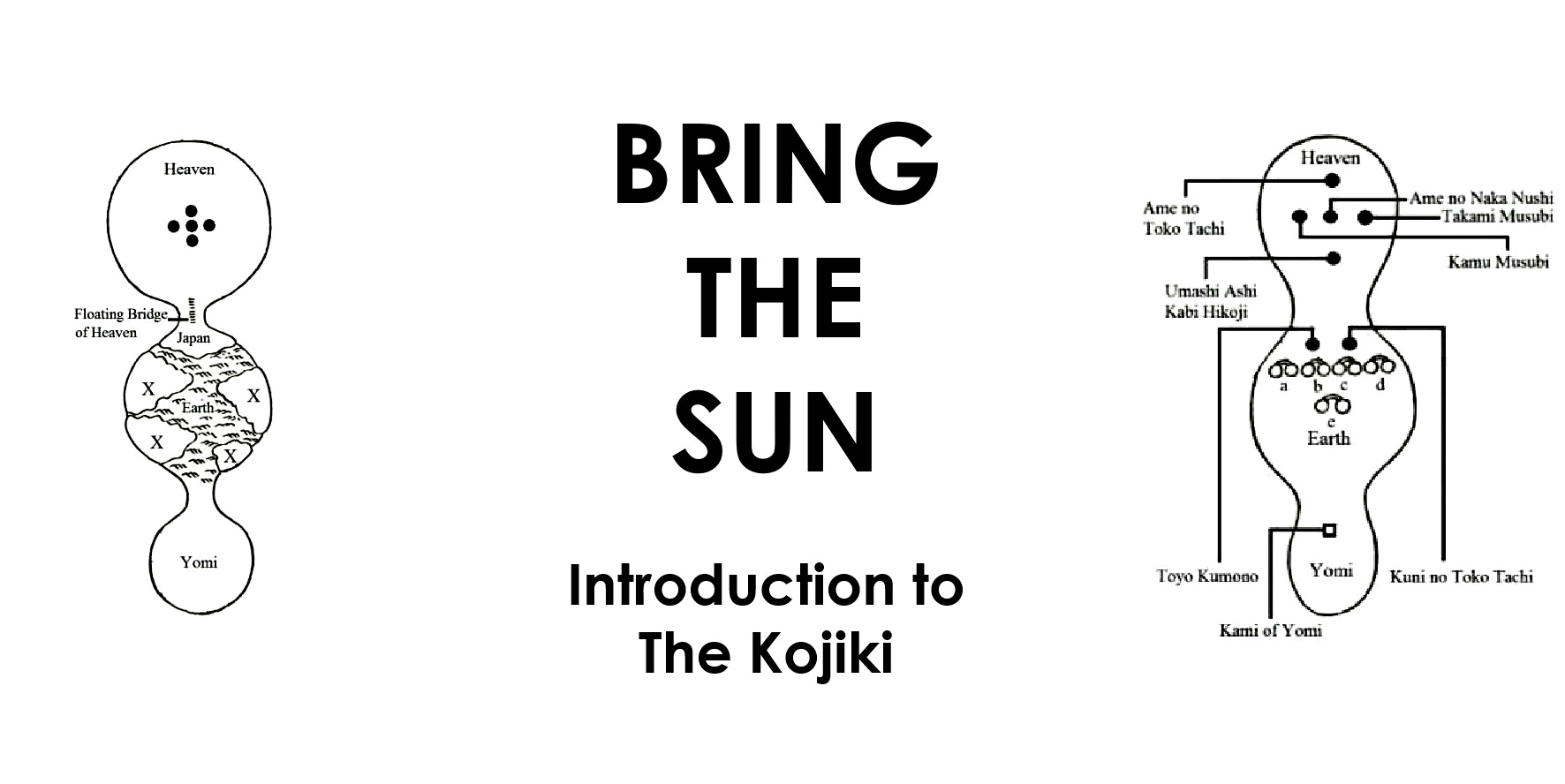
The most sophisticated presentation of the Kojiki’s cosmology was in the essay “Sandaiko,” or “Three Great Inquiries,” composed by a student of Norinaga named Hattori Nakatsune. Through a series of diagrams and written exposition, Nakatsune argued that, instead of the three orbs of the sun, earth, and moon, there had originally been one. “The ancient traditions of the imperial country state there was one globe in the sky,” he writes, “and all objects follow after this.” This orb begins as a primordial heaven, which Nakatsune depicts as a circle, noting however that “the circle is only a temporary illusion. In reality it does not exist. All diagrams that follow are thus metaphorical.” He continues:
Now this sphere divides into three spheres connected by a small passage. The three spheres are heaven, earth, and Yomi. In heaven there appear the first five kami. On the earth, Kuni no Toko Tachi and Toyo Kumono appear. Then, the five paired kami groups appear… In Yomi, there appears the kami of Yomi. Hereafter, heaven, earth, and Yomi gradually separate, but not too far, until they completely separate.
In the earlier stages of this proposed separation, heaven takes on an actual shape on earth like that of Mt. Sumeru in the Indian traditions, accessible through bridges and passageways. Yet as the distance between the two poles of heaven and “Yomi” grows, the three separate orbs start to form. Eventually “the passageway between the three spheres… vanishes, making it impossible to shuttle between the spheres. As an example, it is like cutting the umbilical cord at birth.” Nakatsune elaborates:
Heaven, earth, and Yomi are now independent spheres… Heaven is represented by the sun. Yomi is represented by the moon. As the diagrams represent, in the beginning these three spheres were strung together, like pearls on a string, and heaven was always above the earth, with Yomi always below. These spheres did not move or separate, until the imperial grandson descended from heaven, and then the connection between these spheres was severed.
This means that, in Nakatsune’s words, “the sun is the High Plain of Heaven! But the sun is not Amaterasu. Amaterasu resides in the land within the sun, and she is a kami who rules over the sun.” This marks a difference in the conception of Takamagahara not just with the more materialist Ise Sadatake, but also Nakatsune’s own teacher, Motoori Norinaga.
Interestingly, Nakatsune’s understanding of the Highest Heaven and its eventual separation parallels Evola’s ideas around Hyperborea in that both present us with an original spiritual pole which, at some point, became inaccessible to humanity; or rather it became only accessible through proxies like the gifts of the sun or a divine monarch. This will, of course, remain relevant as we pass through the ages of the Kojiki’s overarching myth arc, but rather than go all in on the Evolian angle and place Takamagahara as a “lost continent,” as interesting as such an assertion may be, we will take a more literal reading and default to the assumption that it is an actual heaven realm located above the earth for the rest of this essay series.
One last detail in the Kojiki which may perplex Western readers is the very beginning of the book; its cosmological creation myth, which we will explore in the next essay. Until then, thank you all very much for reading.
To be continued…