
BRING THE SUN - Chapter 1: The Hyperborean Pole
Solar and Polar Significance in the Kojiki and Nichirenism

“... we consider the origin of the [original] traditions to be Nordic, and even more exactly to be polar, since this is expressly affirmed in the Veda as well as in other sacred books. The land where the sun ‘circled the horizon without setting’ must have in fact been located very near the pole if not at the pole itself.”
-Rene Guenon in “Lord of the World”
Julius Evola’s analytical model can be divided into two types of “qualities”: those of space and time. This is in accordance with Rene Guenon’s position, expounded in his book “The Reign of Quantity and the Signs of the Times,” that “even when quantity is the predominant element, it always appears as more or less mixed with quality; thus it is that the conceptions of space and of time, despite the efforts of modern mathematicians, can never be exclusively quantitative.”
In other words, both space and time are considered primarily, at least in technological modernity, through a “quantitative” lens; e.g. in miles, meters, seconds, minutes, hours, etc. However, there is a persistent “qualitative” side which lingers in spite of our overwhelming quantitative preoccupation. Various landmarks and historical sites are treated with reverence, and annual holidays still hold some sentimental importance in spite of their current commercialized nature.
These kinds of considerations were far more prominent in antiquity, with important temples and capital cities being carefully placed and the procession of eras being of utmost importance. Space and time could intersect as well. Such was the case with the medieval Asian astrologers who determined auspicious and inauspicious days by observing the locations of the celestial houses; i.e. placement of the astral bodies could determine the “quality” of the time. We will see many examples of these principles in action throughout this essay series.
For now, let us elaborate on the first of the two “qualities” mentioned above: Space.
Evola’s framework grounds itself in a pseudo-historical narrative which places the lost land of Hyperborea, situated in the region of the North Pole, as the abode of humanity in a theoretical “Golden Age” in the remote past. As such, the “polar” (or one could say “solar,” but, as we will see, these terms are basically interchangeable) spirituality of Hyperborea, at least what Evola estimates it to be, is superior to all other forms; a traditional ideal. This ideal, however, falls into decline once humanity enters the “Silver Age,” characterized by themes and symbols of “lunar,” earthly, or abyssal significance and overall more passive and “feminine.” Instead of Hyperborea, this later age is represented by the lost continent of Atlantis.
One does not have to accept every facet of Evola’s narrative to utilize this analytical approach, as it is primarily archetypical in nature. Moreover, the axis of “polar” and “southern” does not necessarily indicate a geographical placement; it is a predominately spiritual spectrum, with the “pole” being synonymous with the supreme “principal unity” of Guenonian thought. Distance from the pole (i.e. “southern” nature) is then rather a metaphysical descent towards the decadent realm of base materialism and quantity, represented in Silver Age “Atlantean” spirituality through a preoccupation with fertility and the depths of the earth. On his conception of the Apollonian ideal of Hyperborea, Evola writes:
The Hyperborean stage may be characterized as that in which the luminous principle presents the characteristics of immutability and of centralism, which are, so to speak, typically “Olympian.” These are the same characteristics proper to the Hyperborean god Apollo, who unlike Helios, does not represent the sun following its patterns of ascent and of descent over the horizon, but is rather the sun itself, the dominating and unchanging source of light.
While I myself am a believer in at least some kind of spiritually advanced antediluvian society, the pseudo-historical element will be entirely secondary in my analysis of the Kojiki. This is done more out of necessity than anything else, as the Kojiki, at least in the chapters on The Age of the Gods (which will be our primary focus) does not concern itself with areas outside of the Japanese archipelago. Focusing too much on the possibility of international transmission would risk making the same mistakes outlined in the previous chapter regarding the tantric Buddhist scriptures, i.e. it would place an unproven historical narrative as the driver of the analysis to the potential detriment of sufficiently understanding the text itself, thus leading to likely contradictions and misinterpretations.
This is not to say these elements won’t be mentioned at all. They certainly will be, but only as mere speculation where I feel that the possibility is interesting enough to note. Still, it would do us well to cover the proposed aspects of Hyperborea and its significance in Evola’s pseudo-historical narrative to better understand the analytical framework.
Hyperborea is documented by Greek writers like Herodotus, who once described “sacred offerings bound up in wheat straw” that were “carried from the land of the Hyperborean,” and in Pausanias, Description of Greece, Book 5, we read of “the land of the Hyperboreans, men living beyond the home of the North Wind.” As indicated by Evola, the land is heavily associated with the solar deity Apollo, who was said to migrate there on a flying chariot in the Winter months.
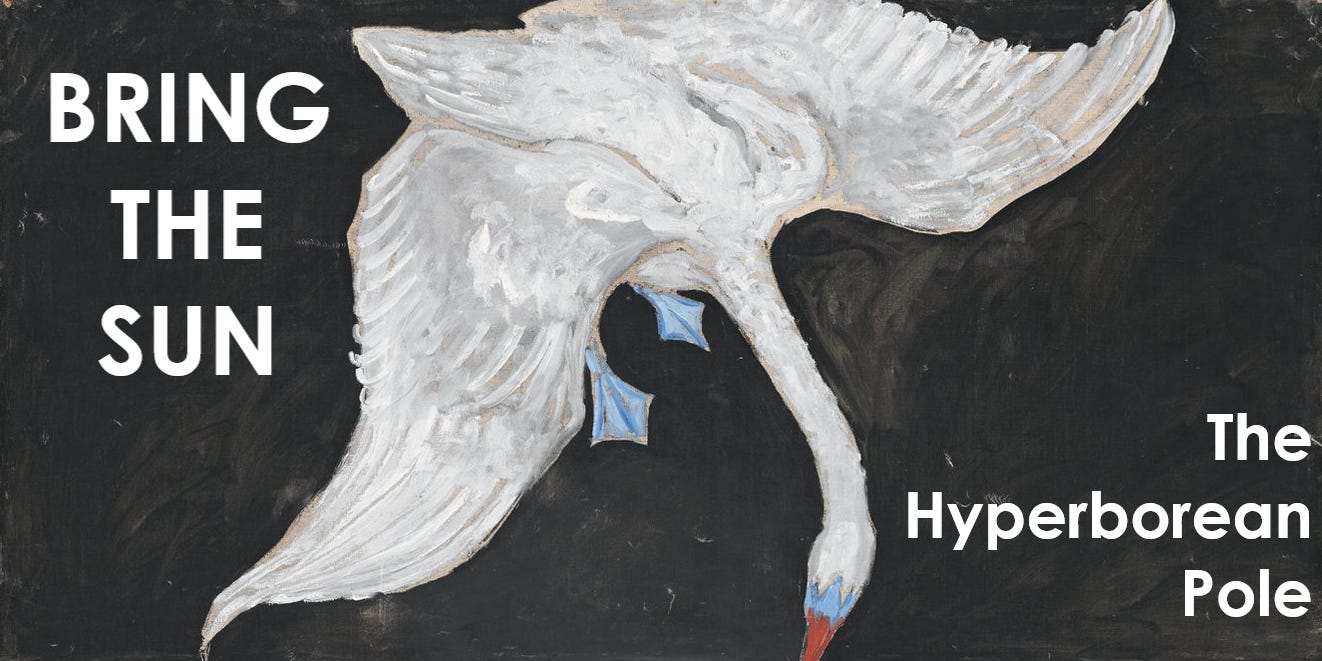
Due to this connection, Hyperborean spirituality is represented by not only the sun, but with birds as well. Apollo’s messenger, it is often claimed, is the white swan. Per the 1969 “Penguin Dictionary of Symbols”:
In myths, this bird of Heaven through its migrations is the link which joins the peoples of the Mediterranean to the mysterious Hyperboreans. Apollo, the god of poetry and prophecy, was born on Delos on a seventh day. On that day sacred swans flew seven times round the island and then Zeus presented the young god with a chariot drawn by white horses, as well as his lyre. His team carried him “first to their home on the shores of the ocean beyond the home of the North Wind, where the Hyperboreans lived under a sky which was always clear”.
In other stories, Apollo’s chariot itself is pulled by white swans instead of horses. This is, in fact, the case regarding one of the earliest accounts of the “Hyperborean Apollo.” Tomislav Bilic writes in his 2016 academic work entitled “The swan chariot of a solar deity”:
The “Hyperborean Apollo” is mentioned for the first time by Alcaeus (born c. 620 BC), unfortunately only in a summary preserved by the 4th century AD rhetorician Himerius. Here, Apollo’s swan-chariot in which the god flew after his birth to the land of the Hyperboreans, whence he returned to Delphi in the middle of summer, is described.
In Claudius Aelianus’ treatise “On Animals,” the symbol of the swan is also merged with another of Apollo’s calling cards: music. He writes on a supposed ancient ritual dedicated to Apollo that was performed by the Hyperboreans:
So when at the customary time they perform the established ritual of the aforesaid god there swoop down from what are called the Rhipaion (Rhipaean) mountains Swans in clouds, past numbering, and after they have circled round the temple as though they were purifying it by their flight, they descend into the precinct of the temple, an area of immense size and of surpassing beauty. Now whenever the singers sing their hymns to the god and the harpers accompany the chorus with their harmonious music, thereupon the Swans also with one accord join in the chant and never once do they sing a discordant note or out of tune, but as though they had been given the key by the conductor they chant in unison with the natives who are skilled in the sacred melodies.
It is, in my opinion, quite fitting that music should be associated with the Hyperborean ideal, which concerns itself with divine order based around a central luminous sphere. Music is, after all, an art based around carefully-tuned order. Just like the stars dancing in the sky above around their central point, music must be played with divine harmony if its cycles, changes, and repeating themes are to be rendered beautiful and fully comprehensible.
Outside of music and the swan, Evola lists an array of other symbols he associated with the solar Hyperborean tradition, writing:
There are different kinds of solar wheels and swastikas: circles, crosses, circles with crosses, and radiating circles; later on, there are axes with a swastika, double axes, and axes and other objects made with aeroliths arranged in a circular pattern; and then images of the “solar ship,” associated with the axes or with the Apollonian-Hyperborean swan and reindeer; all of these symbols are the traces of the original stage of the northern tradition.
Out of all of these, it is the “wheel” and “swastika” which are the most abundant; both, as we will see, common symbols of the Buddhist tradition. Rene Guenon interprets the swastika not as a “solar” symbol, but rather one representing movement around a central point. He states in his book “Lord of the World”:
Contemporary scholars have vainly essayed all kinds of fantastic theories to explain the swastika symbol, but the majority of them, plagued by fixed ideas, have been unable to comprehend it as anything other than an exclusively “solar” sign. If it has occasionally become such a symbol, it can only have been by accident, as a result of some perceiving the swastika as a symbol of movement, although this interpretation, without being false, is far from sufficient, as it acts not from random movement but from a rotation effected around an immutable centre or axis.
This coincides with theories, which I personally subscribe to, that the swastika was inspired by the movement of Ursa Major around the Pole Star; the point which stays unmoved in space throughout the unfolding of the eras. Evola’s interpretation in “Revolt” differs slightly, with him claiming that “the swastika is a solar symbol” but only “inasmuch as it represents a rotary movement around a determined and unmovable pivot corresponding to the center of another solar symbol, the circle.”
While we will hear of various alternatives to Hyperborea as a hypothetical primordial pole of the earth in subsequent essays, the most prominent of these for our purposes is Mt Sumeru, the central mountain in ancient Indian cosmology and abode of the powerful devas, notably located to the north of the known human realm. In integrating Mt. Sumeru into his own theories, Guenon, in his work “Traditional Forms and Cosmic Cycles,” connects this cosmology to his concepts of space and time, interpreting the four continents around the central pillar as various “states” of the mundane world as the cosmic cycle progresses:
In sum, this is a matter of different “states” of the terrestrial world rather than “regions” properly speaking; the Jambu-Dvipa really represents the entire earth in its present state, and if it is said to extend to the south of Meru, the “axial” mountain around which our world revolves, this is because Meru is identified symbolically with the North Pole, so that the whole earth is really situated to the south with respect to it.
In order for us to fully understand the implications of this, however, we must proceed to the second “quality” that characterizes Evola’s analytical paradigm: time.
To be continued…